- Air Homepage
- Weather Radar
- NOAA Radar Weather
How many parts in a NOAA radar weather display system?
Search for more about radar.
The National Weather Service (NWS) website gives us the NOAA radar weather, a network of images and animated loops of weather conditions across the USA. Radar options include base reflectivity, composite reflectivity, and storm total precipitation. A mobile app called "NWS Radar" lets you view radar images and animations on-the-go.
Here's a great national radar map for Americans. Zoom and pan to your location and hit the play button. Or on your phone, try RadarScope, a weather app that provides advanced radar data and analytics, high-resolution radar images, animations, and real-time storm tracking.

Radar for weather? Americans need weather radar because it tells them about severe weather events like thunderstorms, tornadoes, hurricanes, and other natural disasters.
Radar systems let meteorologists and emergency responders track storms and give people advance warnings. For people to stay safe and protect themselves and their properties, they need this info. Radar also helps people plan their daily activities by providing up-to-date weather info. Weather conditions can have a big impact on operations and safety in industries like agriculture, transportation, and construction.
Weather radar helps us stay informed and safe in changing weather conditions and natural disasters.
How does it work?
A weather radar works by sending radio waves into the atmosphere and detecting the waves reflected back by precipitation particles, like raindrops, snowflakes, and hailstones. In a radar system, a beam of radio waves travels outward in a circular pattern, and when it hits precipitation particles, it scatters. Radar antennas detect and measure some of this scattered energy.
Radar uses the time it takes for the radio waves to travel to precipitation particles and back to the antenna to calculate distance. A radar can also estimate precipitation size and intensity by measuring the strength of the returned signals.
Doppler radar is one of the latest technologies used in modern weather radar systems, like NEXRAD. By detecting changes in the frequency of radio waves reflected back, Doppler radar measures precipitation particles' motion.
With this information, you can track storms and predict their future paths by determining the speed and direction of the precipitation.
The components and parts
NOAA radar weather (pronounced like Noah) signals usually go like this:
1) Transmitter - Like a radio communication device, it sends out short pulses of microwave radiation. What's with the pulses? They work, consume less power, and allow the same weather radar equipment time to pick up the reflected signal.

2) Antenna - It focuses the pulse, arriving from the transmitter via a waveguide, and directs it outward. It then sends the incoming signal to...
3) Receiver - This type of image is made possible by the processor that handles incoming goods. It has to clean up the signal first, so it needs a lot of electronics like variable optical attenuators and amplifiers.
It takes a good antenna, receiver, and amplifier, plus lots of muscle; the received signal is a million million million times weaker than the outgoing signal. Decibels are used to represent these huge declines on a logarithmic scale.
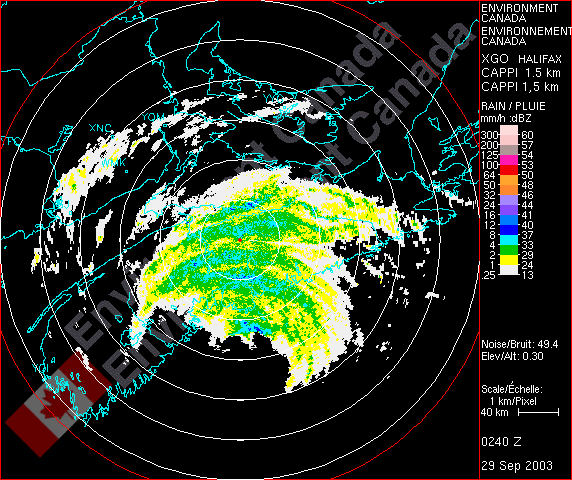
4) Processor and Display - You can look at the screen or paper. It usually shows a
CAPPI output. A CAPPI is a composite image made from several radar scans. There's a nearly horizontal plane in the final image since all the portions are at about the same altitude. Thus, CAPPI stands for Constant Altitude Plan Position Indicator.
Are you familiar with NEXRAD?
Both NOAA radar and NEXRAD (Next Generation Radar) are weather radar systems used in the United States, but they have some key differences.
NOAA radar is a network of weather radars operated by the National Oceanic and Atmospheric Administration (NOAA). Radar systems use a variety of technologies to detect and measure precipitation, including radar waves that bounce off precipitation particles.
On the other hand, NEXRAD is a type of radar used by NOAA. NEXRAD uses advanced technology, including Doppler radar, to give you more detailed weather info. Meteorologists can use this technology to detect precipitation particles' movement and velocity as well as their location and intensity. Forecasts and warnings can be more accurate and timely with this information.
Although NOAA radar refers to the entire network of weather radar systems operated by NOAA, NEXRAD is a type of radar that uses advanced technology to provide more detailed weather information.
#21
Search this site for more information now.
The radar system weather services use has been the subject of entire books.
In addition to NOAA radar weather services:
Weather services in other countries, like Environment Canada Weather in your neighbor to the north, operate local weather radar. Many countries will have their own infrastructure for this. Here's a few examples.
There's the National Meteorological Service in Mexico, the Bureau of Meteorology in Australia, the Nigerian Meteorological Agency in Nigeria, and the Met Office in the UK.
Navigate back from NOAA Radar Weather to the Radar Real Time Weather webpage, or visit the Stuff in the Air homepage.
Can you do it better?
You like this Idea? It works for its intended purpose, but probably is not perfect. Why not?
Do you know of a better one? We'd all like to see it, I'll bet. A penny for your thoughts.
Other people and their ideas...
Click below to see hi-tech contributions from other visitors to this page...
Rhizome Radar 

This is good technology but it is expensive to build and maintain, and if it goes down then the service goes down.
Better to scale down the technology …
new technological weather detection
this is a new technology of weather detection. Using this technology, microwave radio waves are sent out of the antenna and they get deflected by the clouds, …
Now you can get additional meteorology articles by email at the page entitled
Article Meteorology
Recent Articles


-
Methodology Handbook to Master Your Emissions Report
Apr 23, 24 09:24 PM
 Make sure your Quantification Methodology Handbook is clear and compliant. Find out what to include, from data sources to calculations.
 -
Prevention of air pollution assisted by data with the Alberta AEIR
Apr 22, 24 08:33 PM
Check out the AEIR Standard 3.0, which guides industrial operations in reporting emissions, compliance and prevention of air pollution. -
Data Quality Assessment Report Template to Report emissions accurately
Apr 19, 24 12:49 AM
You can use this data quality assessment report template to make sure your emissions reports are accurate and compliant.



Are you familiar with the technology?
There are parts of the NOAA radar weather patterns that show up on the radar and indicate problems in the atmosphere. What is the working principle of the weather radar? Here is a schematic of the system.
Do you have concerns about air pollution in your area??
Perhaps modelling air pollution will provide the answers to your question.
That is what I do on a full-time basis. Find out if it is necessary for your project.
Have your Say...
on the StuffintheAir facebook page
Other topics listed in these guides:
The Stuff in the Air Site Map
And,
Thank you to my research and writing assistants, ChatGPT and WordTune, as well as Wombo and others for the images.
GPT-4, OpenAI's large-scale language generation model (and others provided by Google and Meta), helped generate this text. As soon as draft language is generated, the author reviews, edits, and revises it to their own liking and is responsible for the content.

By Barry Lough, P.Met., EP (Environmental Professional)
Text copyright © 2003-2023 Stuff in the Air.com
BACK TO TOP - Hit your 'Home' Key
New! Comments
Do you like what you see here? Please let us know in the box below.