- Air Homepage
- About us
- Meteorology University Degree
Here is where you can earn a meteorology university degree!
Search for more about education.
How do I get a meteorology university degree - - some people ask this, as well as "where can I study meteorology?" Here's where I got mine.

The information here represents a typical meteorology program program of study. It's important to keep in mind that no two curricula are the same, but here are the basics to get your career started.
The University of Alberta, where I got my meteorology degree, now offers the following courses. The institution is located in Edmonton, Alberta. The majority of the titles and syllabuses have changed since I was there. This is just to give you an idea of what this kind of curriculum looks like.
It is imperative that you achieve good grades as soon as possible. Matriculation Grade 12 English, Chemistry, Mathematics, and Physics are required to get into any science program at the U of A. And one of these options:
- Biology
- Advanced Math, usually Calculus
- Social Studies
- Other Language
- Fine Arts Subject (Art; Drama; Music)
- Physical Geography
- Other
Science definition
Science is the systematic process of observing, exploring, and experimenting to understand the world. Human civilization advances through continuous discovery and understanding. New technologies and complex problems are solved with science.
Science is about observing and experimenting with the natural world. It involves making hypotheses, doing experiments, and analyzing data to draw conclusions Science is the systematic study of the structure and behavior of the physical and natural world through observation and experiment. It's possible to use the scientific method to study how temperature affects gas behavior, for instance.
Alternatively, some people think science is just a way to understand the natural world, without necessarily involving experiments. It sounds more like pure philosophy. They say science is more about observation and formulating theories about how things work, and experimentation is just one tool.
Philosophy studies existence, knowledge, values, reason, mind, and language. With its critical, generally systematic approach and reliance on rational arguments, it's different from other approaches. As is mathematics, it's a valuable contributor to science. They're all partners, really
Math is the study of numbers, shapes, and patterns. The development of logic has involved abstraction and mathematical reasoning. Science, engineering, and economics all use math.
We are NOT Geeks
At least that's what some people think. Do you think math helps us to understand our world? Succeed at work? Use a computer?
You bet. That reminds me, it can help make you a better gambler if you're so inclined.
What's the most important thing math helps you with?
What Other Great Mathemeticians Have Said...
Click below to see contributions from other visitors to this page...
meteorology schools 

Where are meteorology schools? I have a bit of a problem - more like stress. I would love to be a meteorologist because I love to know more about the …
Air pollution study
I'm trying to plan an air pollution study. How can I start the air pollution modelling at first stage? I want to start my M.Sc. thesis.
Barry's …
GEOLOGY Not rated yet
l'M PRESENTLY STUDYING TO GET MY CREDITS FOR VOLCANOLOGY, BUT I ALSO ENJOY STUDYING METEOROLOGY, MY ALGEBRA IS VERY WEAK.
Oh yes, I enjoy watching …
formulas to check pressure at hight altitud Not rated yet
I need to set up an air compressor at ground level and run an air hose 200 feet height. What is the air pressure change at that height?
Barry's Response …
For your meteorology university degree, you will need to take certain college courses
This is where my classes and the meteorology university degree offices were:
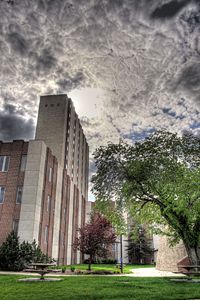
They've since moved to this newer building.

Here are some brief technical descriptions of my meteorological program's core topics.
Environmental Physics I - Fundamental calculations such as
concentrations, balances,
lapse rates, exponential growth and decay. Also conduction,
convection and
radiation.
Introduction to Environmental Earth Science – Weather and climate. Atmospheric and ecological processes, hydrological cycle. Stuff in the
Air issues such as storms and
pollution. Many of these concepts are given with a Canadian perspective.
Violent Weather – All the fun stuff.
Mesoscale meteorology. Tornadoes,
hurricanes, hail and lightning. They are examined from both a scientific and
safety viewpoint. Expect to find meteorology of storms tests and exercises.
Introduction to Computational Techniques in Earth and Atmospheric Sciences – Software and techniques. How math relates to meteorology.
Spatial problems and computing experience.
The Atmosphere –
Composition, temperature,
air masses and weather maps.
Environmental Instrumentation – Lab course with a field trip. Electronics and
instrument calibration and use. Data sampling theory.
Applied Atmospheric Physics – An analytical look at temperature, pressure, humidity, evaporation, condensation, dew,
freezing, ice,
frost, convection, clouds, rain, hail, rainbows, solar and terrestrial radiation. The importance of
thermodynamics in meteorology.
Atmospheric Fluid Dynamics –
How fluids flow around a rotating planet. Large scale meteorological concepts such as
vorticity, jet streams, the
atmospheric boundary layer, upper level
waves and stability. One of the fundamentals for your meteorology degree.
Weather Analysis and Forecasting – What is
synoptic meteorology? Weather maps and charts. Weather systems as well.
The Climate System – Radiation, the hydrological cycle,
atmosphere-ocean interactions, climate history, change and feedback. Even some climate modeling.
Clouds and Storms –
Cloud physics, droplets and precipitation,
radar, and convection.
Atmospheric Modelling – General circulation models, numerical weather prediction, other models and various methods. The
power of the computer in forecasting.
Advanced Climatology – Climate models and recent
developments in climatology. Scientific land and air transactions.
The Atmospheric Boundary Layer – Turbulence and diffusion. Dimensional analysis and scales of motion. Similarity theories,
disturbed windflows and plume dispersion modeling.
Advanced Clouds and Storms – Cloud physics. Ice formation, precipitation processes, weather modification, numerical
cloud models and precipitation forecasting.
Climates and Ecosystems – Terrestrial environments in various climatic zones.
Anthropogenic influences and effects on agriculture.
Meteorology Speciality
At this institution, you can get a Diploma in Meteorology if you already have a science degree. You'd be able to apply for the federal operational meteorology internship program with it. This choice isn't available at all meteorology schools.
After one more year of study, it adds a meteorology major to an existing degree. You could say it converts a general B.Sc. into a meteorology university degree.
Go back from Meteorology University Degree to the Weather Man webpage, or search this site for more information now.
Recent Articles


-
Methodology Handbook to Master Your Emissions Report
Apr 23, 24 09:24 PM
 Make sure your Quantification Methodology Handbook is clear and compliant. Find out what to include, from data sources to calculations.
 -
Prevention of air pollution assisted by data with the Alberta AEIR
Apr 22, 24 08:33 PM
Check out the AEIR Standard 3.0, which guides industrial operations in reporting emissions, compliance and prevention of air pollution. -
Data Quality Assessment Report Template to Report emissions accurately
Apr 19, 24 12:49 AM
You can use this data quality assessment report template to make sure your emissions reports are accurate and compliant.


What are the requirements for obtaining a meteorology university degree?
An example of how to obtain a meteorology degree from a university. Courses in meteorology, air studies, requirements, and descriptions.
Do you have concerns about air pollution in your area??
Perhaps modelling air pollution will provide the answers to your question.
That is what I do on a full-time basis. Find out if it is necessary for your project.
Have your Say...
on the StuffintheAir facebook page
Other topics listed in these guides:
The Stuff in the Air Site Map
And,
Thank you to my research and writing assistants, ChatGPT and WordTune, as well as Wombo and others for the images.
GPT-4, OpenAI's large-scale language generation model (and others provided by Google and Meta), helped generate this text. As soon as draft language is generated, the author reviews, edits, and revises it to their own liking and is responsible for the content.
Quaecumque vera is a Latin phrase that means "Whatever is true." It emphasizes the importance of seeking truth in all aspects of life. Often, it's used to encourage people to seek knowledge, live honestly, and pursue knowledge.

By Barry Lough, P.Met., EP (Environmental Professional)
Text copyright © 2003-2023 Stuff in the Air.com
BACK TO TOP - Hit your 'Home' Key
New! Comments
Do you like what you see here? Please let us know in the box below.