- Air Homepage
- Let it Snow
- Physics of Ice Skating
The Physics of Ice Skating
The art of figure skating. Is it a sport or a performance art? It's a science, the physics of ice skating.
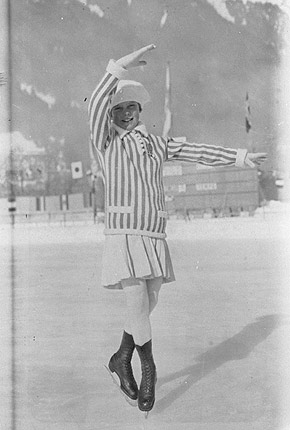
The physics of ice skating has several valuable implications for skaters, coaches, and even researchers. Here's what you get:
- You can improve your performance on the ice by knowing physics. Skaters can optimize their movements, reduce energy wastage, and perform jumps, spins, and footwork more efficiently by understanding friction, momentum, and balance. Skaters can refine their techniques and get better control, stability, and precision by applying scientific concepts.
- Figure skating injuries can be prevented with physics knowledge. Injuries can be prevented if skaters understand the forces and impacts involved in jumps and landings. By making informed decisions about technique adjustments, equipment choices, and training methods, they can reduce the risk of stress-related injuries.
- Technique Development: Physics explains the mechanics behind figure skating. For different elements, you analyze and optimize your body positioning, angles, and timing. By applying physics principles, skaters can improve their technique, maximize jump heights and distances, increase spin rotations, and improve overall performance.
- Figure skating equipment choices and technological advances can be influenced by physics. Skaters can make informed equipment decisions by understanding the interaction between skates and ice and the impact of blade design, materials, and sharpness. Using motion capture systems and force platforms, researchers and coaches can analyze skaters' movements and optimize training programs using scientific data.
- Coaches who understand the physics of ice skating are better at teaching their skaters. Science can help skaters understand the mechanics behind their movements by explaining and demonstrating techniques. Skaters' skills and performance can also be enhanced with physics-based exercises and drills designed by coaches.
- Understanding ice skating's physics contributes to ongoing research and innovation. Biomechanics of figure skating movements, and the effects of various factors on performance are studied by scientists and engineers. Skaters and the sport as a whole can benefit from advances in equipment design, training methods, and performance analysis tools.
We'll start with the skating shoe, which has a thin piece of metal on the outside of its sole. There's a minimal area that touches the ice, but it's long and wide enough to prevent the person's weight from slicing into the surface.
How does that help skaters? Due to the lowest practical surface area in direct contact, the result is reduced friction.
I've got more. Ice skating has another factor that reduces friction. High pressure forms a layer of liquid water between solid ice and the blade's edge.
Water layers are thin, a few thousand molecules or less, and even thinner at low temperatures. Ice itself is slippery enough, so a pressure-induced liquid film isn't necessary for smooth motion. It's still slippery even at temperatures so cold that pressure can't melt it, so the age-old theory doesn't hold water.
In a manner similar to graphite lubrication, molecules near the surface stay in a partial liquid state regardless of temperature and pressure.
In the Physics of Ice Skating, vorticity plays an important role
Meteorology's concept of vorticity describes horizontal rotation in the atmosphere, and more generally, the extent of circulation or rotation of any fluid.
In a similar way, you can think of it as another part of ice skating physics.
You spin me around like a record:
Get some more great songs on Youtube.
Like a gyroscope or spinning bicycle wheels, angular momentum helps stabilize skating bodies, so they don't fall down.
Studying an ice skater's spin is a great way to explain another skating-physics concept called angular momentum. When the skater brings her hands closer to her body, the speed of spinning increases so that the moment is maintained.
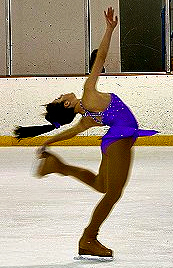
Even though the speed, angular velocity, will increase upon compression, the area each element of mass sweeps out relative to the axis will remain constant, minus a little friction loss.
Spinning also depends on torque, which leads to rotation. Ice is pushed to create this force.
Skaters often do multiple spins in edge jumps, for example. Jumps like double-axel are airborne because of the torque created by turning the skate as it lifts off.
When landing, our skater stretches her hands and legs for stability, but pulls in her hands closer to her body for more rotational speed.
When she practices, she'll be able to use these forces to her advantage, which makes for impressive figure skating.
A figure skater's ability to make exciting movements has nothing to do with ice skating physics. It's the practice, the effort and fluid motion they put in with little regard to theory.
We'll think about the physics instead, those of us who aren't so graceful. Now back to our first question?

Figure skating is often considered a combination of sport, performance art, and science. I'll give you an overview of each:
- Sport: Figure skating is undeniably a sport that requires strength, endurance, flexibility, and technical skill. Skaters train hard to perfect their jumps, spins, footwork, and lifts. Winter Olympics and World Championships showcase figure skaters' athletic prowess as they perform intricate routines and compete for scores.
- Figure skating incorporates elements of performance art, with skaters aiming to create visually captivating and emotionally engaging routines. During their performances, they use music, choreography, body movements, facial expressions, and costumes to express themselves. Skaters try to engage and entertain the audience while demonstrating their artistic interpretation of the music.
- Ice skating's science and physics support the art of figure skating. For skaters to execute their movements effectively and efficiently, they need to understand friction, momentum, balance, and angular momentum. Skaters can perform jumps with rotational forces, maintain stability during spins, and control their movements on ice if they understand these scientific principles. Skaters need scientific knowledge to maximize their performance and minimize their energy use.
Understanding the physics of ice skating improves performance, prevents injuries, refines technique, helps make informed equipment choices, improves coaching methods, and drives research and innovation. Figure skaters and stakeholders can optimize their approach to figure skating, leading to improved results and advancements.
In figure skating, you'll find the technical athleticism of a sport, the creativity and expressiveness of a performance art, and the application of scientific principles. In order to create captivating and technically impressive routines, skaters strive to balance these aspects.
Recent Articles


-
Methodology Handbook to Master Your Emissions Report
Apr 23, 24 09:24 PM
 Make sure your Quantification Methodology Handbook is clear and compliant. Find out what to include, from data sources to calculations.
 -
Prevention of air pollution assisted by data with the Alberta AEIR
Apr 22, 24 08:33 PM
Check out the AEIR Standard 3.0, which guides industrial operations in reporting emissions, compliance and prevention of air pollution. -
Data Quality Assessment Report Template to Report emissions accurately
Apr 19, 24 12:49 AM
You can use this data quality assessment report template to make sure your emissions reports are accurate and compliant.



Is it possible for you to imagine the physics of ice skating?
Ice skating over a frozen winter lake is a wonderful experience. Is it possible to move over ice? What about the physics of ice skating?
Do you have concerns about air pollution in your area??
Perhaps modelling air pollution will provide the answers to your question.
That is what I do on a full-time basis. Find out if it is necessary for your project.
Have your Say...
on the StuffintheAir facebook page
Other topics listed in these guides:
The Stuff in the Air Site Map
And,
Thank you to my research and writing assistants, ChatGPT and WordTune, as well as Wombo and others for the images.
GPT-4, OpenAI's large-scale language generation model (and others provided by Google and Meta), helped generate this text. As soon as draft language is generated, the author reviews, edits, and revises it to their own liking and is responsible for the content.
You are here:
Most Popular Pages on this Website:
Pictures of Global Warming
- See photos, cartoons, charts, graphs and a few surprises.
Clouds
- Don't know a cumulus from a stratus? Check here.
Causes of Global Warming
- It's not always obvious.
Calgary Alberta Weather
- Example of Canadian Goodness.
Thermometers
- Our favourite weather instrument.
- Home
- Contact Us
- Free E-zine Back Issues
- Privacy Policy
- Site Map - I'll help find something good.

By Barry Lough, P.Met., EP (Environmental Professional)
Text copyright © 2003-2023 Stuff in the Air.com
BACK TO TOP - Hit your 'Home' Key
New! Comments
Do you like what you see here? Please let us know in the box below.