- Air Homepage
- Weather Maps
- Atmosphere Lesson Plans
Atmosphere Lesson Plans: Exciting Experiments to Spark Curiosity
See more about the atmosphere.
Meteorology and atmosphere lesson plans start with the basics. What kinds of things do we have in mind? Temperature, wind, rain, and atmospheric pressure.
Being a physical-science teacher is incredibly rewarding because you get to help students understand complex concepts and theories. Additionally, you love watching their curiosity grow and seeing them apply what they learn.
Weather and meteorology can be a fun and engaging way for kids to learn science, math, and the world around them. Weather and meteorology can be fun for kids for a variety of reasons. Here are some:
- It's fascinating: Kids are naturally curious about the world around them, and weather is a fascinating subject. Young learners can really enjoy studying weather patterns, cloud formations, and the science behind weather events like thunderstorms and hurricanes.
- Kids can learn a lot about weather by doing hands-on experiments. The kids can observe and record weather data, make weather instruments like wind vanes and barometers, and even make their own weather forecasts.
- Studying weather can give kids the power to predict what's going to happen next. Kids can learn about weather patterns and use weather instruments to predict what the weather will be like and see if they're right.
- Environmental awareness: Studying weather can also help kids understand their environment and how weather events affect it. Weather affects plant growth, animal behavior, and even human activities like farming and transportation.
Summary - nine engaging ways to get kids interested in meteorology:
- Make mini tornadoes or demonstrate the water cycle.
- Keep track of the weather every day.
- Make weather crafts, like homemade weather instruments.
- Make sure you introduce age-appropriate books, websites, and videos about weather.
- Take field trips to weather stations or meteorological centers.
- Learn about weather with games and apps.
- Get kids involved in citizen science projects.
- Invite guest speakers from meteorology or climate science to do weather-themed role plays.
- Provide answers to their weather-related questions and encourage questioning.
What is so important about air pressure?
Here's an example: Start these atmosphere lesson plans with air pressure experiments...maybe with a map called "barometric pressure today". Here's a simple drawing of a low pressure system with a trough and two fronts.
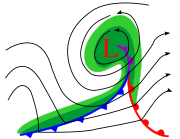
There's a warm front in red and a cold front in blue. If you're in the Northern Hemisphere, the arrowheads show typical wind directions.
You can even use a technical term: Isobaric analysis.
Weather forecasters use this method to identify surface highs, lows, ridges, and troughs. This is done by drawing curves joining all the locations on the map that have equal, or nearly equal pressure readings. You'll end up with a pattern of contours like this. Why? Cloud patterns and fronts are consistent in lows.
What's the deal? As before, we draw isobars (curves) connecting points with equal pressure for several levels until they get a pattern like the one above.
How about having fun with your students and doing a great job? Show them how to do it in class. It might look like the thin dark curves above with a low or high value in the middle.
Just like this one, meteorologists use pressure maps all the time.
There's a higher pressure area between two adjacent lows. So what? What's the difference between highs and lows? Lows and troughs are typically associated with clouds and precipitation - in other words, typical low air pressure weather.
It's more complicated than that, and the people who do this study a lot of physics. In low-pressure areas, air rises and cools, causing clouds to form. In high-pressure areas, it's the opposite. Clouds don't form when air moves downward.
The joy of maps
These fun and interactive methods will help your child learn about weather maps in a fun way. Using creative and interactive methods, you can teach kids about weather maps. Here are some ideas:

- Show your kid real weather maps from newspapers, online sources, or TV weather reports. Learn what the different symbols and colors mean and how they relate to the weather.
- Draw a weather map with your kid: Make a weather map together. Use different colors to represent different weather conditions, like blue for rain, yellow for sunshine, and gray for clouds. Draw pictures of the sun, raindrops, or snowflakes to represent the weather.
- Hang a weather chart on the wall so your student can track the weather. Each day, use symbols or stickers to represent the weather. Discuss any patterns or trends you see in the chart with your child at the end of each week.
- Demonstrate different weather conditions with your child by conducting simple experiments. To make clouds, fill a jar with water and add shaving cream. Put food coloring on the "clouds" to make rain.
- Read age-appropriate books or watch educational videos about weather with your kid. Relate what they learned to real-world weather.
Atmosphere Lesson Plans for classroom instruction
The weather is important to children for several reasons, and they might find it interesting to learn about it:
Children are affected by the weather in many ways, such as what they wear or what activities they can do. Children can make better decisions about how to spend their day by understanding the weather. Kids love weather patterns and phenomena like lightning, tornadoes, and hurricanes. Children can learn about weather and appreciate the natural world.
It's important for the environment: Weather affects everything from plant growth to animal behavior on our planet. When kids understand how weather affects our planet, they'll appreciate how important it is to take care of it.
Learning about weather can lead to learning about geography, math, and science. Children can learn more about the world around them by making connections between weather and other subjects.
Discussing the weather is a common way to start conversations and connect with others. Children can engage in these conversations and connect with their neighbors by learning about the weather.
It's fun and important for kids to learn about the weather. Making it fun and engaging helps kids develop curiosity and appreciation. Have a look at this longer list of ideas for teaching.
...or sign up for a series of free email meteorological articles. Go back from Atmosphere Lesson Plans to the Forecast Map Weather web page now.
Search this site for more information now.
Recent Articles


-
Methodology Handbook to Master Your Emissions Report
Apr 23, 24 09:24 PM
 Make sure your Quantification Methodology Handbook is clear and compliant. Find out what to include, from data sources to calculations.
 -
Prevention of air pollution assisted by data with the Alberta AEIR
Apr 22, 24 08:33 PM
Check out the AEIR Standard 3.0, which guides industrial operations in reporting emissions, compliance and prevention of air pollution. -
Data Quality Assessment Report Template to Report emissions accurately
Apr 19, 24 12:49 AM
You can use this data quality assessment report template to make sure your emissions reports are accurate and compliant.



Here are some atmosphere lesson plans that you can use to excite your students
You will find some lesson plans on air pressure as well as some fun experiments below.
Do you have concerns about air pollution in your area??
Perhaps modelling air pollution will provide the answers to your question.
That is what I do on a full-time basis. Find out if it is necessary for your project.
Have your Say...
on the StuffintheAir facebook page
Other topics listed in these guides:
The Stuff in the Air Site Map
And,
Thank you to my research and writing assistants, ChatGPT and WordTune, as well as Wombo and others for the images.
GPT-4, OpenAI's large-scale language generation model (and others provided by Google and Meta), helped generate this text. As soon as draft language is generated, the author reviews, edits, and revises it to their own liking and is responsible for the content.

By Barry Lough, P.Met., EP (Environmental Professional)
Text copyright © 2003-2023 Stuff in the Air.com
BACK TO TOP - Hit your 'Home' Key
New! Comments
Do you like what you see here? Please let us know in the box below.