- Air Homepage
- Air Quality Modelling Service
- Air Quality Testing
- AERMOD Model
AERMOD model Explained: How Air Dispersion Modelling Works
The AERMOD model is a regulatory air dispersion tool used to estimate how pollutants released by industrial sources move through the atmosphere and affect air quality at surrounding locations. It combines emissions data, meteorology, terrain and source characteristics to calculate predicted concentrations at selected receptors.
The model is widely used in industrial air-quality assessments because it represents important atmospheric processes while providing a structured framework for regulatory analysis.
Its results can help answer practical questions: Will a proposed facility meet applicable air-quality objectives? Which operating scenario produces the greatest impact? Could a change in equipment or emissions reduce that impact?
The answers depend on the quality of the inputs, the modelling configuration and the assumptions behind each scenario. AERMOD provides estimates for defined conditions. It does not eliminate uncertainty or guarantee that actual concentrations will match predictions.
This guide explains how the modelling system works, which inputs matter most and how to interpret its results. It also identifies the decisions that can make the difference between a defensible assessment and an expensive modelling exercise that fails to answer the original question.
AERMOD model at a glance
The AERMOD modelling system has three principal components:
- AERMOD calculates pollutant dispersion and predicted concentrations.
- AERMET processes meteorological data and derives parameters describing atmospheric turbulence and stability.
- AERMAP processes terrain elevation data and calculates terrain-related information for model receptors.
Other tools support specific tasks. For example, AERSURFACE helps estimate surface characteristics used in meteorological processing and BPIPPRM prepares building dimensions for building-downwash calculations.
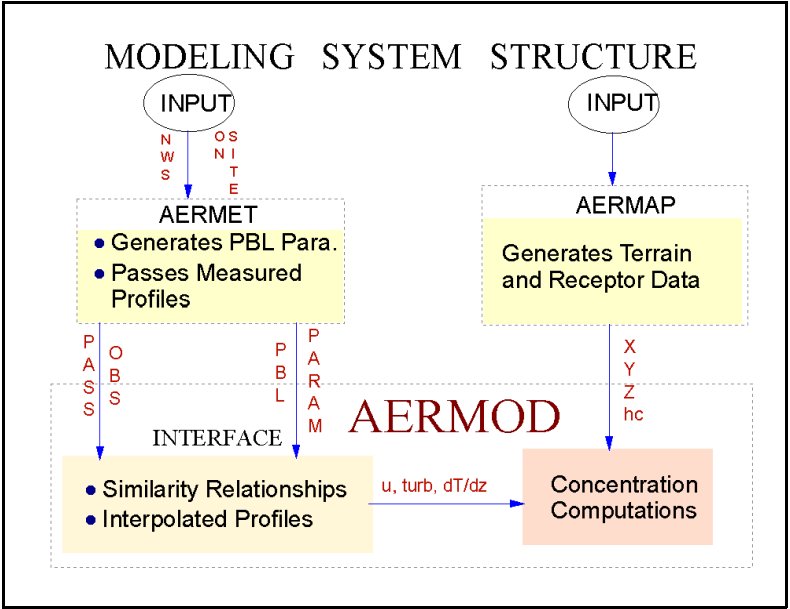 Seamless integration
AERMOD is a steady-state plume model. In practical terms, it uses hourly meteorological conditions to estimate concentrations under the assumption that the conditions represented during each modelled hour are sufficiently steady for its formulation to apply. It can represent point, area, volume and other supported source types, as well as simple and complex terrain.
The model's scientific formulation has evolved since its development by the American Meteorological Society and US Environmental Protection Agency. The AERMOD model replaced ISC3 in the US regulatory framework in 2006.
Which version should you use?
The US EPA released AERMOD version 26135 in 2026, together with updated supporting tools and documentation. The appropriate version for a Canadian project must also be checked against the applicable regulator's requirements, project approvals and modelling guidance. Using the newest executable without checking those requirements is not a sound version-selection strategy.
See the US EPA AERMOD support page for current software, documentation and release notes.
1. How AERMOD predicts concentrations
AERMOD estimates how emissions travel away from their sources, how the plume spreads and how much pollutant reaches a particular location. Four processes are especially important.
Plume rise: Hot exhaust and high-velocity releases can carry pollutants above the physical release point. Buoyancy and momentum influence the plume's rise, while wind speed and atmospheric stability affect its trajectory.
A taller effective plume may reduce ground-level concentrations near a source while shifting the location of greater impacts farther downwind. The outcome depends on the source, the weather and the surrounding environment.
For a flare or industrial stack, the modeller therefore needs defensible information about emission rates, release temperature, exit velocity, release height and operating conditions. Errors in these inputs can affect the predicted concentrations.
Atmospheric turbulence and dispersion: Wind transports a plume while atmospheric turbulence spreads it horizontally and vertically. The AERMOD model uses different treatments to represent dispersion under convective and stable conditions.
 What does Turbulence Mean?
During sunny conditions, heating of the ground can create rising and sinking air currents. This convective turbulence mixes pollutants vertically. At night, surface cooling often produces a more stable atmosphere with weaker vertical mixing.
These differences matter because a plume that disperses readily in one set of conditions may remain concentrated in another. AERMOD's calculations account for atmospheric stability, turbulence and the changing wind profile with height.
Terrain: Hills and valleys influence the relationship between a plume and the ground. The AERMOD model uses terrain information processed by AERMAP to represent receptor elevations and terrain-related effects.
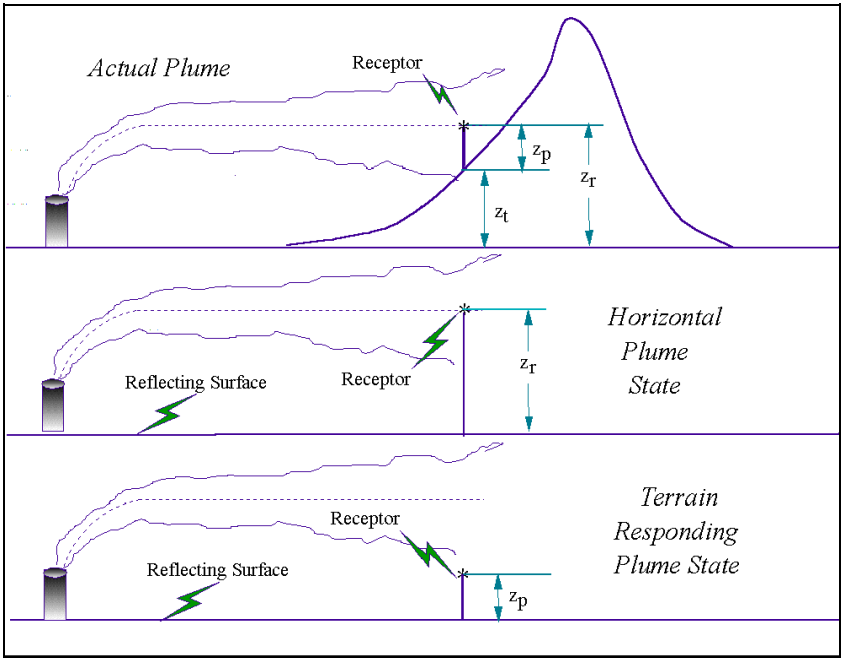 Various conditions for pollutant dispersion
Complex terrain can affect where the maximum predicted concentration occurs. A receptor placed at an unsuitable elevation or an overly coarse receptor grid can miss a location that deserves closer examination.
Building downwash: Buildings can disrupt the wind and create turbulent wakes. These wakes may pull an elevated plume downward, increasing concentrations near the ground, near the facility.
 Characterizing sources for modeling
AERMOD incorporates the PRIME building-downwash algorithms to represent relevant wake effects.
The calculation depends on accurate building dimensions, source locations and stack parameters.
Building downwash is a good example of why running the software is only part of the job.
The modeller must first establish which buildings matter and how to represent them.
2. Meteorology: The foundation of the calculation
Meteorological data can be among the most consequential choices in an air dispersion assessment. Wind speed, wind direction, atmospheric stability and mixing height all influence how pollutants move and disperse.
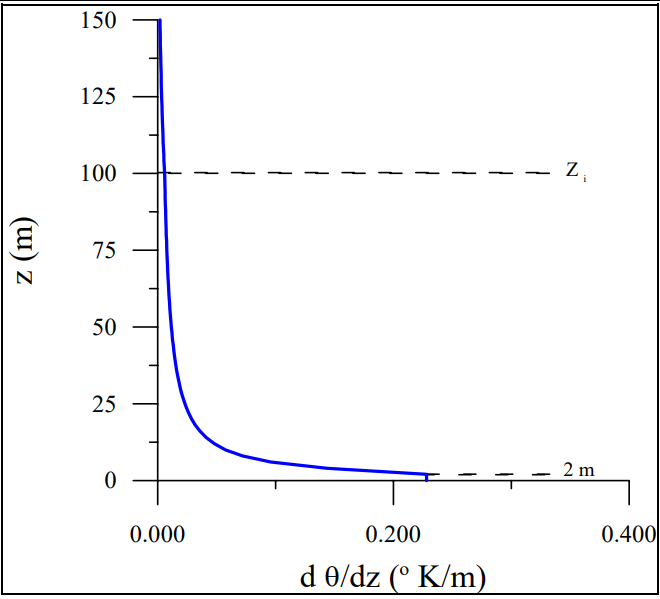 Insights into heights and dispersion
What does AERMET do? AERMET processes meteorological observations and derives parameters needed by the AERMOD model. Depending on the available data and processing approach, these include wind profiles, turbulence parameters and characteristics of the atmospheric boundary layer.
AERMET also requires information about the surface beneath the atmosphere being modelled. Three important surface characteristics are:
- Surface roughness: how the ground and its features affect airflow.
- Albedo: the fraction of incoming solar radiation reflected by the surface.
- Bowen ratio: the relationship between sensible heat transferred to the atmosphere and latent heat associated with evaporation.
These characteristics help describe how the surface exchanges heat and momentum with the air above it.
A simplified surface energy balance is commonly expressed as:
(Rn = H + λE + G)
 Mastering Solar fluxes and Heat fluxes
Here, net radiation (Rn) is distributed among sensible heat flux (H), latent heat flux (λE) and ground heat flux (G), using this sign convention. The balance helps explain why the same weather conditions can produce different atmospheric mixing over different surfaces.
AERMET uses the available observations and prescribed methods to estimate the parameters required by the model. These estimates depend on the quality and representativeness of the data.
Stable and convective conditions: The planetary boundary layer is the lowest part of the atmosphere, where the Earth's surface directly influences airflow and turbulence.
 Dynamics of plumes
During the day, surface heating can produce a convective boundary layer. At night, surface cooling can create a stable boundary layer. The depth of the layer in which pollutants mix, commonly described using mixing height, influences vertical dispersion.
AERMOD uses meteorological parameters prepared by AERMET to represent these changing conditions. The underlying calculations are sophisticated, but the practical question is straightforward: Does the meteorological dataset reasonably represent the conditions that control pollutant transport at the site?
Where does the meteorological data come from? Potential sources include regional observations, processed numerical weather prediction data and site-specific monitoring. Each has strengths and limitations. More detailed measurements do not automatically produce a more representative dataset, particularly where the monitoring location differs from the facility's terrain or surface characteristics.
 Meteorology and Pollution Dispersion
In Alberta, one established resource is the province's meteorological data for dispersion models. The published dataset uses Weather Research and Forecasting (WRF) model data for 2015–2019 on a 4 km grid. MMEU2 can extract and format these data for use in regulatory modelling.
At Calvin Consulting, this dataset is one of our preferred starting points for applicable Alberta assessments. Its suitability still needs to be evaluated for the particular site and project. The data period, terrain, source location, regulatory expectations and availability of better-supported alternatives all matter.
MMEU2 is a meteorological data extraction and formatting utility. It does not replace AERMET's role in preparing the meteorological parameters required by the AERMOD model.
Several of our projects are located in Northern Alberta, where actual data gathering locations are scarce and/or relatively new, and the Alberta WRF/MMEU2 dataset is frequently the most complete available dataset for these environments.
3. Emission sources and operating scenarios
AERMOD can represent several source types, including point sources such as stacks, area sources, volume sources and supported roadway or line-source configurations. The correct representation depends on the physical release and the purpose of the assessment.
Source characterization often requires more judgement than expected. The modeller may need to establish:
- Emission rates for each pollutant and operating scenario.
- Stack or release height, diameter, temperature and exit velocity,
- Building dimensions and the relationship between buildings and sources,
- Whether sources operate continuously, intermittently or under specific upset conditions,
- Which operating conditions are credible and relevant to the regulatory decision.
A model cannot compensate for an emission rate that does not represent the scenario being assessed. Likewise, a technically sophisticated simulation can provide a misleading answer if an important source or operating condition is omitted.
For flaring assessments, the relationship between gas composition, fuel-gas addition and pollutant emissions may be especially important. Changing the gas mixture can change the H₂S content of the flare stream and the resulting SO₂ emission rate. The effect on predicted concentrations must be evaluated using the actual scenario inputs and the applicable flare-emission calculation method.
In our experience at Calvin, temporary flaring looks simple on the surface, but the air‑quality story underneath is anything but. Curious how?
 Clarification of regulations and data
That example illustrates an important modelling principle: a useful assessment tests the variables that could change the decision. The aim is to understand the relationship between operating conditions and predicted impacts rather than generate large quantities of output without a clear purpose.
4. Terrain, receptors and the location of maximum impact
AERMOD calculates concentrations at specified receptor locations. Receptors may represent property boundaries, nearby residences, sensitive locations or a grid covering the surrounding area.
The placement and spacing of receptors can affect whether the maximum predicted concentration is identified. A coarse grid may be suitable for understanding broad spatial patterns but can be inadequate near a source or property boundary where concentration gradients are steep.
A defensible receptor design considers the source layout, terrain, nearby buildings, relevant land uses and the distances at which significant impacts could occur. Fine spacing can be used where it is needed to locate maxima or resolve a particular feature, with wider spacing farther away where appropriate.
The modeller also needs to distinguish the location of the highest predicted concentration from the location where people or other receptors may be exposed. Those questions overlap, but they are not always identical.
In the majority of projects we carry out at Calvin Consulting, air quality models in Alberta exclude on‑site receptors because ambient standards apply only beyond facility boundaries; workplace air quality is handled separately under OHS rules.
5. Specialized modelling: NO₂, urban effects and model options
Some assessments require additional treatments beyond the basic dispersion calculation.
 Beautiful Outdoor Air Quality
Nitrogen dioxide - Combustion sources emit nitrogen oxides (NOₓ), which include nitric oxide (NO) and nitrogen dioxide (NO₂). Their atmospheric chemistry affects the predicted NO₂ concentration.
AERMOD supports methods for estimating NO₂ from NOₓ emissions, including the Plume Volume Molar Ratio Method (PVMRM), the Ambient Ratio Method (ARM2) and other types of Generic Reaction Set Method (GRSM). These methods use different assumptions and inputs. Their suitability depends on the source, available information and applicable regulatory guidance.
Selecting a method solely because it produces the lowest predicted NO₂ concentration is not defensible. The choice should be justified by the regulatory basis, the available data and the physical situation being modelled.
Urban effects - Urban surfaces can retain and release heat differently from rural surfaces. The resulting urban heat island can influence turbulence and mixing. The AERMOD model includes treatments for urban boundary-layer effects where the relevant conditions and settings apply.
ALPHA and other specialized options - AERMOD documentation describes options at different stages of development. Their availability and status can change between releases. An option's presence in the software does not automatically make it a regulatory default or establish that its use is accepted for a particular application.
Before enabling an option, modellers are best advised to confirm its purpose, maturity, implementation in the model version being used and acceptance under the applicable regulatory framework. Record the reason for the choice so the assessment can be reviewed and reproduced.
For current details, consult the EPA's AERMOD documentation and release notes.
6. How to evaluate an AERMOD result
A concentration value has little meaning until the reader knows what it represents. A proper interpretation should identify:
- The pollutant and averaging period. A one-hour maximum and an annual average answer different questions.
- The modelled scenario. State the emission rates, operating conditions and other assumptions behind the result.
- The receptor location. Identify where the concentration occurs and whether it represents a relevant location.
- Background concentrations. Explain whether and how background air quality was included.
- The applicable objective or criterion. Use the correct jurisdiction, pollutant, averaging period and statistical form.
- The important limitations. Describe any material uncertainty or data constraint that could affect interpretation.
Model results can also be tested through sensitivity analysis. A modeller might examine alternative emission rates, source parameters, meteorological assumptions or other inputs to determine whether a plausible change could materially affect the conclusion.
 Dispersion and Conversion with Precision
Sensitivity analysis should be targeted. Its purpose is to identify which assumptions matter to the decision, not to produce an arbitrary collection of additional runs.
A recent Calvin Consulting example
For an anonymized Alberta gas-plant assessment, Calvin Consulting used the AERMOD model with five years of Alberta Environment and Protected Areas WRF meteorological data for 2015–2019, processed using AERMET. The assessment included elevated terrain, building downwash, a multi-scale receptor grid extending to 10 km and PVMRM for NOₓ-to-NO₂ conversion. A nearby compressor-station source was also considered.
Including the applicable background NO₂ concentrations, the predicted results were:
Metric
Predicted concentration
Alberta Ambient Air Quality Objective
One-hour NO₂
95.9 µg/m³
300 µg/m³
Annual NO₂
12.4 µg/m³
45 µg/m³
The assessment predicted compliance with both objectives for the scenarios modelled. This conclusion applies to the defined emissions, meteorological data, model configuration and assumptions in that assessment.
The value of the exercise was in the complete analysis: choosing a defensible meteorological dataset, representing the source and terrain, accounting for nearby emissions, selecting an NO₂ conversion method and comparing the resulting concentrations against the appropriate objectives.
7. What makes a defensible modelling assessment?
The most important decisions often occur before the model is run.
 AERMOD Computer Model
A defensible assessment begins with a clear question and a realistic description of the emissions. It uses suitable meteorological and terrain information, represents relevant buildings and receptors, documents the selected model configuration and evaluates the results against the correct criteria.
The appropriate level of effort depends on the decision at stake. An assessment for a routine approval may need a different level of detail from an emergency-release evaluation or a project involving complex terrain and nearby sensitive receptors. Practicality and cost matter, but the model must still be capable of answering the question and meeting the applicable regulatory requirements.
Experienced judgement helps identify where additional work is worthwhile. It can also prevent unnecessary analysis by distinguishing consequential uncertainties from details unlikely to change the decision. The economic principle is simple: better decisions come from understanding what drives the result, rather than assuming that more complexity automatically produces a better answer.
When should you bring in an air-quality modeller?
AERMOD can be downloaded and run by anyone with the necessary software and technical knowledge. Producing a model output file is relatively straightforward compared with establishing whether the result is fit for its intended purpose.

The difficult work includes selecting the appropriate modelling approach, building a defensible emissions inventory, evaluating meteorological data, configuring source and receptor inputs, understanding regulatory requirements and explaining what the results do and do not establish.
Mistakes can lead to unnecessary modelling costs, delayed approvals or conclusions that need to be revisited. The consequences may be particularly significant where the assessment supports a major capital decision, an operating change or an emergency planning requirement.
Calvin Consulting Group Ltd. provides air-quality dispersion modelling and technical support for industrial projects in Alberta and British Columbia. With approximately 30 years of combined team experience, we help clients:
- define the question,
- select a practical and defensible approach,
- evaluate predicted impacts and
- prepare clear technical reports for regulatory review.
Our approach starts with the decision the assessment needs to support. We then determine which data, model features and sensitivity checks are necessary to answer that question with appropriate confidence.
Planning an air-quality assessment? Contact Barry at Calvin Consulting Group Ltd. to discuss your project, the information you already have and the modelling approach that fits your technical and regulatory needs.

A well-designed AERMOD assessment should do more than produce concentration contours. It should give you a clear basis for deciding what to do next.
A certified Environmental Professional (EP) will provide you with the best assistance on your project.
Recent Articles


-
Ambient Air Quality Monitoring Equipment Station Siting: AMD Chapter 3
Oct 29, 26 03:22 PM
 Learn Alberta AMD Chapter 3 siting requirements for ambient air quality monitoring equipment, wind instruments and samplers. Practical guidance.
-
Ambient Air Monitoring Equipment Specifications
Oct 25, 26 05:01 PM
 Chapter 4 of Alberta's Air Monitoring Directive, specifying ambient air monitoring equipment and technical requirements for good air quality data.
-
Alberta Air Monitoring Directive - AMD Compliance Guide
Oct 22, 26 03:21 PM
Understand the Alberta Air Monitoring Directive, monitoring requirements, quality assurance, audits and reporting. Practical guidance for industrial facilities.



With this air quality model, we're transforming our future.
American scientists developed the AERMOD model in seven steps, including creating it, testing it, evaluating its performance, beta testing, and getting public feedback. AERMET and AERMAP process weather and terrain data to help predict pollution movement. In replacing the ISC3 model, this design challenges old ideas and brings in a new era of environmental protection.
Do you have concerns about air pollution in your area??
Perhaps modelling air pollution will provide the answers to your question.
That is what I do on a full-time basis. Find out if it is necessary for your project.
Have your Say...
on the StuffintheAir facebook page
Other topics listed in these guides:
The Stuff-in-the-Air Site Map
And,
Thank you to my research and writing assistants, and the author remains responsible for the content.
You are here:
Most Popular Pages on this Website:
Pictures of Global Warming
- See photos, cartoons, charts, graphs and a few surprises.
Clouds
- Don't know a cumulus from a stratus? Check here.
Causes of Global Warming
- It's not always obvious.
Calgary Alberta Weather
- Example of Canadian Goodness.
Thermometers
- Our favourite weather instrument.
- Home
- Contact Us
- Free E-zine Back Issues
- Privacy Policy
- Site Map - I'll help find something good.

By Barry Lough, P.Met., EP (Environmental Professional)
Text copyright © 2003-2026 Stuff in the Air.com
BACK TO TOP - Hit your 'Home' Key