- Air Homepage
- Canadian Weather
- Weather in Alberta Canada
- Calgary Weather
Calgary weather forecasts
Here's the latest Calgary weather forecast from Environment and Climate Change Canada.
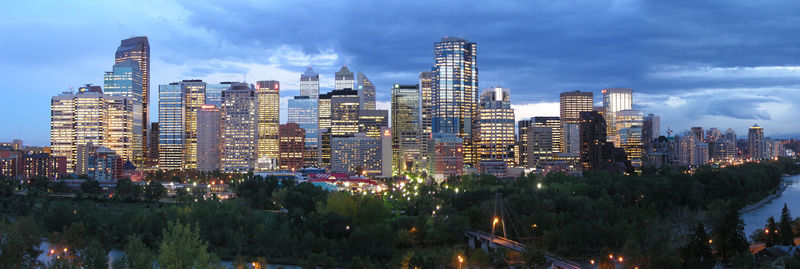
Here is a link for current satellite imagery. Use the link at the top to see Calgary's six-day weather forecast.
How might our weather in Calgary affect you? The climate in Calgary is humid continental, with warm summers and cold winters. Calgary's climate is influenced by the Canadian Prairies and the Rocky Mountains. Rainfall in the region is generally low, but it can vary a lot.
There are four distinct seasons in Calgary. Calgary's location in the foothills of the Rocky Mountains makes it prone to sudden weather changes, so visitors might want to know what kind of weather to expect.
Where to get the info: The Weather Network, Accuweather, Weather Underground, WeatherSpart and Weather Channel can also tell you what kind of weather Calgary AB Canada is going to get.
If you want a second opinion, The Weather Network, Accuweather, Weather Underground and Weather Channel will also tell you what kind of weather Calgary AB Canada is to expect. Get easy-to-read climate info with WeatherSpark. You can change cities or switch between Fahrenheit and Celsius on all of them.
What do you think of the latest Calgary Alberta weather forecast? Below is a chart that compares it to Calgary's climate.
We can use this summary of Climate in Calgary Canada to teach people to never be unprepared. There could be extreme temperatures, wind, rain, snow, or even nice weather in Calgary. Imagine that!
The Calgary International Airport, YYC, lies about 10 kilometres northeast of the city centre. It reports the official temperatures but the downtown temperatures are usually warmer than the airport. That's because of differences in:
- Albedo (resistance to sunlight absorption),
- The urban heat island effect (direct sources of heat within the largest city on the prairies) and
- Wind exposure
...for instance.
Calgary weather history
Here's some weather history for this city. A different site was used for Calgary weather observations between 1919 and 1939, near Bowness. Afterward, the airport moved to a spot west of where it is now. All locations combined, the warmest day was 36.1°C (97°F) on July 15, 1919, and the coldest day was -45°C (-49°F) on February 4, 1893.
We usually have highs in the low to mid 20s in July, minus 5 in January, and overnight lows in the -10 to -20 range during the winter. There are weather extremes in Calgary, though. They're more common east of the city. This is the average daily high temperature throughout the year, with each month denoted by its first letter.

On the left, the temperature scale, corresponding to daily highs,starts at -6°C (about 21°F) and goes up to 24°C (75°F). In July the day-night average is just over 15 degrees, and in January it's about -9.
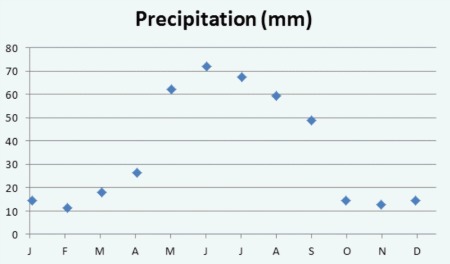
Next graph: Precipitation is highest in June with about 80mm, with less than 20mm (as melted snow) in each of the winter months, which go from November to March. Here's a plot of average monthly precipitation.
The city gets 169 frost free days a year on average. We normally have 115 consecutive frost free days per season, from May 23 to September 15, after the growing season ends. Some of the others occur in the fall and even winter (during Chinooks).
Calgary's wild weather is partly because of its continental climate. Some of the credit goes to the turbulent winds and low humidity in the wake of the Rocky Mountains, too.
About 85 days a year, the temperature hits 20°C or higher. Only four times does it normally get above 30°. A chinook wind or cold front can change the temperature by 10° or more in an hour.
Another thing to consider is how much heat or air conditioning you'd use in a typical year. A degree-day tells you how much above or below 18°C the temperature stays, and for how long.
To calculate potential energy consumption, simply multiply the number of degree-days below 18 degrees by the usage of heating in any city. The same goes for degree days over 18 and air conditioning use, though most people in Calgary don't even own an air conditioner. Wind exposure, building design, temperature settings, and the amount of bright sunshine will also affect actual usage.
On average, Calgary weather gives us about 40 degree-days above 18 degrees, which isn't much. We also get 5100 degree-days below 18°C, so you won't survive the year without heating. The heating total for Calgary is a lot lower than most of the rest of the Canadian Prairies.
How's Calgary's precipitation? There's a dry season and a moist season in Calgary. In an average year, the city gets a little over 400 mm of total water. Between October and April, we get 120 cm of snow, which melts down to 120 mm of water. That's when it's drier.
More Calgary weather facts
On July 15, 1927, there was 95.3 mm (about four inches) of rain. That's the most and it probably happened during a thunderstorm. On May 6, 1981, there was 48.4 cm of snow (nearly two feet). There's usually some kind of precipitation 113 days a year. We usually have 88 days with 1 cm or more of snow on the ground.
Winds around here are also worth mentioning. It's windy all year round in southern Alberta. Calgary's highest gust of 127 km/hour was in June, 1956, probably during a thunderstorm. Not during one of our famous winter Chinooks. However, it's no surprise that December and January have the most days with winds over 50 km/hour on average because of the Chinook winds.
Every month of the year, the most frequent wind direction is west or northwest. Wind chill bites when it's cold. About 3 times a year, this calculated chill index drops to minus 40 or worse.
Do you get a lot of sun here? With over 2400 hours of sunshine on average per year, Calgary has one of the sunniest climates in Canada.
This next Environment Canada page compares Calgary climate with other Canadian cities. In this list of 100 cities, Calgary ranks #77 for warm summers (Kamloops is #1). Change the rank-order list on the right by clicking another category on the left (e.g., Rainiest city).
In winter, it can be sunny, bright, cold, and windy at the same time. Something to experience. Visit this Calgary Real Estate page if you are interested in Calgary and would like to learn more about the city and its neighbourhoods.
Recent Articles


-
Methodology Handbook to Master Your Emissions Report
Apr 23, 24 09:24 PM
 Make sure your Quantification Methodology Handbook is clear and compliant. Find out what to include, from data sources to calculations.
 -
Prevention of air pollution assisted by data with the Alberta AEIR
Apr 22, 24 08:33 PM
Check out the AEIR Standard 3.0, which guides industrial operations in reporting emissions, compliance and prevention of air pollution. -
Data Quality Assessment Report Template to Report emissions accurately
Apr 19, 24 12:49 AM
You can use this data quality assessment report template to make sure your emissions reports are accurate and compliant.





Now is the time to compare weather forecasts for Calgary.
Would you like to see a few different perspectives on Calgary's weather? With this Calgary climate data, you can compare forecasts from different providers.
Do you have concerns about air pollution in your area??
Perhaps modelling air pollution will provide the answers to your question.
That is what I do on a full-time basis. Find out if it is necessary for your project.
Have your Say...
on the StuffintheAir facebook page
Other topics listed in these guides:
The Stuff in the Air Site Map
And,
Thank you to my research and writing assistants, ChatGPT and WordTune, as well as Wombo and others for the images.
GPT-4, OpenAI's large-scale language generation model (and others provided by Google and Meta), helped generate this text. As soon as draft language is generated, the author reviews, edits, and revises it to their own liking and is responsible for the content.
You are here:
Most Popular Pages on this Website:
Pictures of Global Warming
- See photos, cartoons, charts, graphs and a few surprises.
Clouds
- Don't know a cumulus from a stratus? Check here.
Causes of Global Warming
- It's not always obvious.
Calgary Alberta Weather
- Example of Canadian Goodness.
Thermometers
- Our favourite weather instrument.
- Home
- Contact Us
- Free E-zine Back Issues
- Privacy Policy
- Site Map - I'll help find something good.

By Barry Lough, P.Met., EP (Environmental Professional)
Text copyright © 2003-2023 Stuff in the Air.com
BACK TO TOP - Hit your 'Home' Key
New! Comments
Do you like what you see here? Please let us know in the box below.