- Air Homepage
- Air Quality Modelling Service
- Air Quality Dispersion Modelling
- Certified Regulatory and Compliance Professional
Certified Regulatory and Compliance Professional: Air Quality Modelling Skills and Professional Judgement
In this article, Certified Regulatory and Compliance Professional refers specifically to professionals working in air-quality regulatory, compliance and dispersion-modelling applications. It is not a finance, investment or financial-compliance designation.
What does a Certified Regulatory & Compliance Professional working in air quality actually need to know? Running AERMOD or CALPUFF is only part of the answer.
A defensible air-quality assessment requires someone who can understand emissions, meteorology, terrain, receptors, buildings, regulations, data quality and the physical meaning of the results.
More importantly, that person has to know when to question the information in front of them. That is one of the less glamorous (and more important) parts of professional air-quality modelling.
A good modeller doesn't just ask, Did the model run? They ask, Does the model represent the real problem well enough for us to trust the answer?
That is the central skill behind the certified regulatory and compliance professional role in air-quality work.
Air Quality Modelling 101: The Model Is Not the Answer
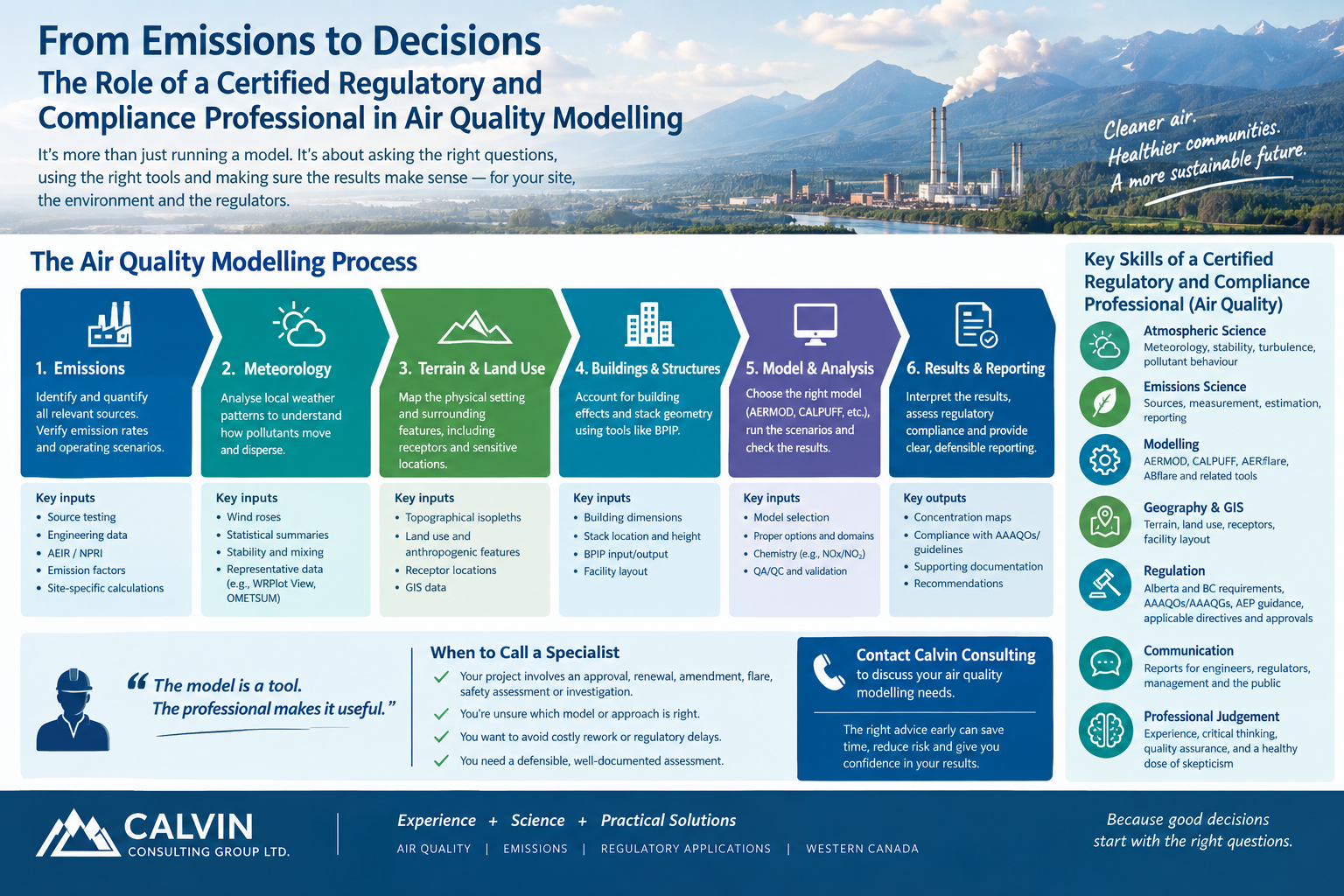
Air-quality dispersion modelling takes a complicated physical problem and turns it into something we can calculate. The basic chain looks like this:
Emissions → Meteorology → Dispersion → Receptors → Predicted concentrations → Regulatory decision
The computer performs enormous numbers of calculations and the professional has to decide what those calculations should represent. That distinction matters.
A model can be technically correct and still answer the wrong question if the emissions are wrong, the operating scenario is incomplete, the receptors are poorly selected, the facility is represented incorrectly, or the chosen model is inappropriate for the physical situation.
That is why the certified regulatory and compliance professional working in air quality needs more than software skills.
What does the certified regulatory and compliance professional actually do?
 Experts in air quality
A typical modelling assessment begins by defining its purpose. The scope might support:
- an approval or renewal application;
- an amendment to an existing facility;
- a safety assessment;
- an internal engineering or environmental investigation;
- a regulatory request;
- an emergency or unusual operating scenario; or
- a client or legal investigation.
That purpose determines what questions the model needs to answer. The opening paragraphs of a good technical report should make that scope clear. Only then does the detailed modelling work begin.
1. Understand the Emissions
A certified regulatory and compliance professional needs to understand where the emission rates came from. The number in a spreadsheet is not automatically a fact.
At Calvin Consulting, emissions may be developed from equipment information, stack testing, CEMS data, operating records, flare information, published emission factors, AEIR information, NPRI information, engineering calculations or other project-specific sources.
We also prepare Alberta Annual Emissions Inventory Report (AEIR) Quantification Methodologies and submission forms for many clients. Over the years, Calvin has developed an extensive set of procedures and techniques for determining emission rates and other source parameters for equipment such as:
- storage tanks;
- engines;
- external combustion equipment;
- fugitive emissions;
- flares; and
- other industrial sources.
The important question isn't simply: What number did the client give us? It is: Is this the appropriate number for the scenario we are trying to model?
A professional may find that information is incomplete, inconsistent with other records, or physically implausible. That's when professional judgement begins.
2. Check the Information Before Trusting It
One of the most useful skills in air-quality consulting is knowing when to doubt the data. Instead of assuming that everyone else is wrong, this is about checking whether the pieces fit together.
A stack diameter might disagree with an engineering drawing. An emission rate might not match the equipment's expected operating condition. A production rate might imply emissions very different from those reported elsewhere. A source might be missing altogether.
An operating scenario might be described as 'maximum' even though another condition actually produces the greater predicted ground-level concentration.
These are not unusual modelling questions. They are part of the job.
The certified regulatory and compliance professional needs enough technical understanding to recognize when something deserves a second look.
And sometimes the investigation leads somewhere unexpected: The problem is the input, not the model.
3. Understand the Atmosphere
Processing meteorological data isn't simply a matter of producing a file and clicking 'run.'
At Calvin Consulting, meteorological processing commonly includes examining windroses and statistical summaries of the data. Windroses and statistical charts may be produced using tools such as WRPlot View from Lakes Environmental Software or the summary functions available through the oMETSUM tab associated with AERflare workflows.
The modeller needs to ask:
- What directions does the wind normally come from?
- How variable are the winds?
- What wind speeds occur?
- Are calm conditions important?
- Do unusual predicted concentrations correspond to identifiable meteorological conditions?
- Does the meteorology appear representative of the site and modelling purpose?
 Assessing impact of weather
Weather data contain patterns. Those patterns help explain the model results.
A maximum concentration that initially looks strange may become understandable when you discover that it occurs during a particular combination of wind direction, stability and source operation.
That is one reason the certified regulatory and compliance professional needs meteorological understanding rather than treating weather files as anonymous computer inputs.
4. Build the World Around the Facility
Before discussing predicted concentrations, we want to understand the physical setting.
At Calvin, modelling reports commonly include a topographical isopleth drawing showing terrain, broad land-use information, anthropogenic features and receptor locations.
Rather than merely decoration, that map is a check on whether the digital model resembles the actual site. A professional should be able to look at the map and ask:
- Where are the sources?
- Where are the nearby facilities?
- Where are the receptors?
- What does the terrain look like?
- Are there buildings, roads, settlements or other features that matter?
If the digital representation doesn't make sense before the model is run, a technically successful model run won't rescue it.
This is an important lesson for anyone learning certified regulatory and compliance professional air-quality practice: the model is a representation of a place, not an abstract mathematics exercise.
5. Receptors: Where Do We Ask the Model to Look?
A model calculates concentrations at receptor locations. That sounds simple. But it isn't.
Receptor design can affect whether the assessment actually captures the maximum concentration or the locations that matter to the regulatory question. And depending on the assessment, receptors may include:
- Cartesian grid receptors;
- fence-line receptors;
- sensitive receptors;
- discrete locations;
- high-density grids; or
- elevated receptors such as flagpoles.
A professional has to decide where additional receptors are useful rather than simply adding thousands of points everywhere. More receptors are not automatically better.
The useful question is: Where could the model reasonably produce an important result that we need to see?
6. Buildings Can Change the Problem
A stack in an open field and the same stack beside a large building are not necessarily the same dispersion problem. Buildings can alter airflow, causing downwash and other effects that may change the plume's behaviour.
Calvin's modelling work uses BPIP to parameterize buildings and stack locations for applicable models. Reports include BPIP input and output so the geometry used in the modelling can be reviewed. That means checking things such as:
- building dimensions;
- peak roof heights;
- building tiers and shapes;
- stack location;
- stack elevation;
- nearby structures; and
- whether the digital representation corresponds to the actual facility.
Again, the certified regulatory and compliance professional is not merely checking whether BPIP produced output. The question is whether BPIP was supplied with the right physical information in the first place.
7. Choose the Model for the Question
Model selection is one of the clearest examples of professional judgement.
In Alberta, modelling requirements depend on the regulatory situation and the characteristics of the assessment. Screening and refined approaches have different purposes, and Alberta identifies AERMOD-PRIME and CALPUFF among the refined modelling systems used for appropriate applications.
AERMOD is often the practical choice for conventional industrial assessments. CALPUFF may become appropriate where the physical problem calls for treatment of time- and space-varying meteorology, complex terrain, long-range transport or other specialized circumstances.
The choice should never be: CALPUFF is more advanced, so it must be better. Nor should it be: AERMOD is easier, so use AERMOD.
The right question is: Which modelling approach adequately represents the physical and regulatory problem? See our AERMOD vs CALPUFF guide for a deeper discussion.
8. Think About the Chemistry
Not every pollutant behaves the same way. Some contaminants can be treated primarily as directly emitted substances. Others may transform after release.
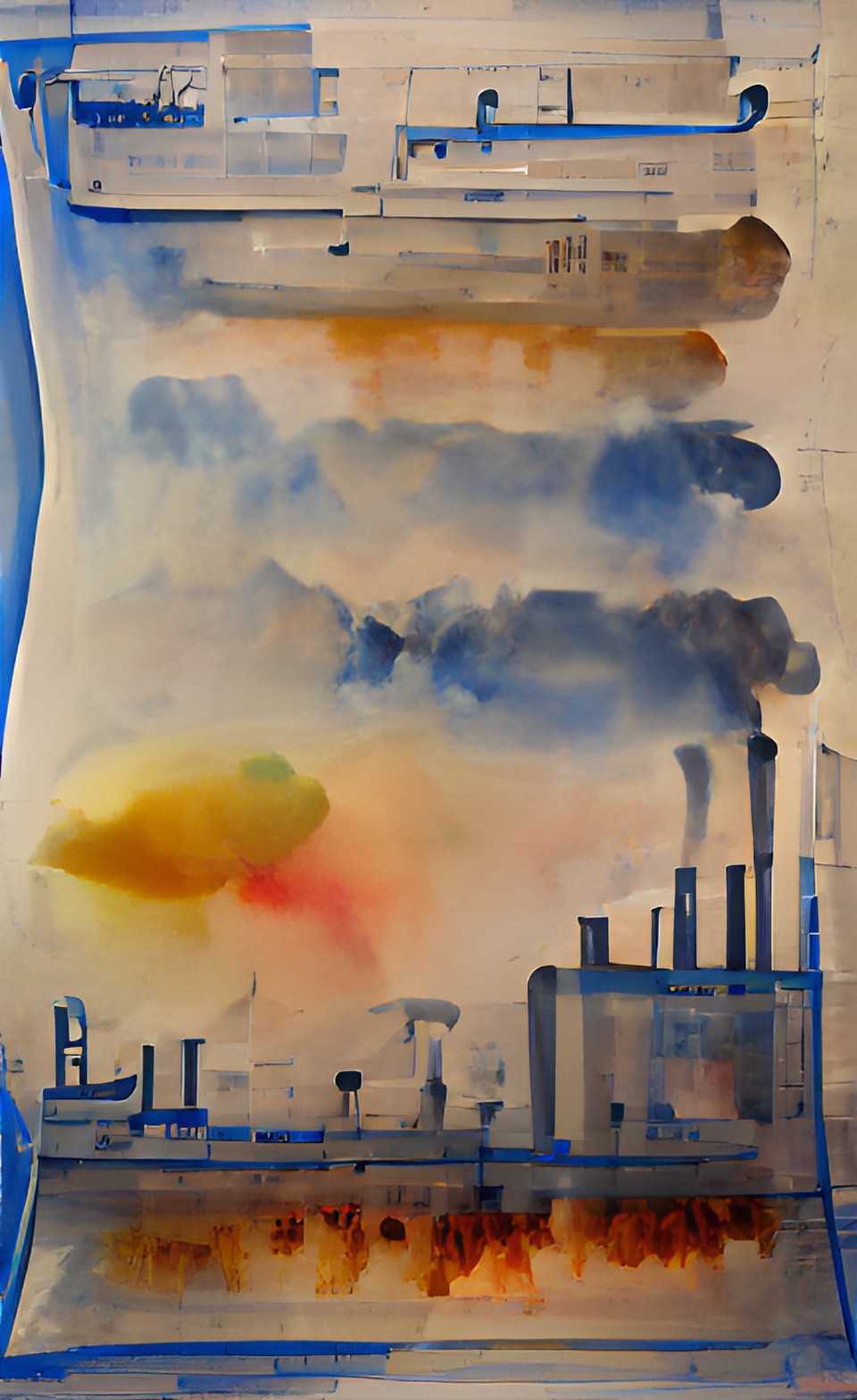 How to control air Pollution
NOx and NO₂ are an obvious regulatory example. Depending on the assessment, chemical transformation may have to be represented appropriately.
Secondary particulate matter and ozone create much more complicated problems. A certified regulatory and compliance professional therefore needs enough atmospheric chemistry knowledge to recognize when the simple dispersion problem is no longer sufficient.
This does not automatically mean using the most complicated model available. It means knowing when the simpler model no longer answers the question.
9. Understand Flares and Changing Emissions
Flaring provides an excellent lesson in why professional modelling is more than putting an emission rate into a box. A flare's release conditions can change substantially with flow, temperature and other operating parameters. As well as wind speeds.
For non-routine flaring, AERflare and related tools can determine source parameters needed for dispersion modelling.
Blowdowns are even more interesting. AERflare can represent a transient flare using representative phases. By default, the blowdown can be divided into three equal-mass phases.
The first two phases may occur relatively quickly. The third, sometimes called the tailout period, can continue much longer as pressure falls toward the end of the event. It is entirely possible for this final phase to become the controlling condition for a particular averaging period.
That provides an excellent real-world example of mathematical modelling: The phase releasing the most pollutant at any instant is not necessarily the phase that produces the maximum ground-level concentration.
You have to understand both the emissions and the atmosphere.
10. Quality Assurance Means More Than Checking the Software
A software run can complete successfully and still contain a serious modelling problem. Quality assurance therefore operates at several levels.
The modeller needs to check:
- Input quality - Are the source data complete and internally consistent?
- Model setup - Are the options, domains, receptors and source representations appropriate?
- Physical plausibility - Do the results behave as expected?
- Regulatory relevance - Does the assessment answer the regulatory question?
- Documentation - Can another experienced reviewer understand what was done and why?
Calvin's reports go through several levels of review. One of the questions reviewers ask is model representativeness: Does the modelling approach adequately represent the physical situation and the purpose of the assessment?
That question is much more valuable than simply asking whether the model ran without errors.
A Good Modeller Is Professionally Skeptical
There is a certain amount of doubt built into good modelling. Not a weakness. But a safety mechanism. A modeller should be willing to ask:
- Is this emission rate complete?
- Why does this maximum occur here?
- Why does this scenario produce a higher concentration?
- Is the meteorology appropriate?
- Are the receptors adequate?
- Does the building representation make sense?
- Is this result consistent with the engineering?
- Are we using the right model?
- Is modelling even the appropriate way to answer this question?
 Clean-air bubbles
At Calvin, modellers discuss unusual situations with one another, challenge assumptions and learn from previous work. Not just to remove uncertainty.
The goal is to identify uncertainty that can be reduced, understand what remains, and make sure the conclusion doesn't claim more than the analysis can support.
That is one of the most important characteristics of the certified regulatory and compliance professional working in air quality.
What Happens When the Result Looks Strange?
Don't immediately change the model. Investigate. A strange result might indicate:
- an input problem;
- a source-characterization problem;
- a receptor issue;
- unusual but legitimate meteorology;
- building interaction;
- terrain effects;
- an averaging-period effect;
- or something that genuinely deserves further technical investigation.
One of the worst habits in modelling is changing assumptions simply because the answer isn't what you expected. Better to ask: What physical mechanism is producing this result?
Sometimes the model is telling you something useful, or the model is exposing a mistake in your assumptions. Either way, investigating the result is part of the job.
Why This Matters to Industry
Air-quality modelling isn't simply about producing maps full of coloured contours. A defensible assessment can influence:
- whether a facility can be approved;
- how equipment is designed;
- emission limits;
- operating conditions;
- flare requirements;
- safety decisions;
- monitoring programs;
- regulatory responses; and
- whether additional engineering or modelling is actually necessary.
That is why getting the modelling approach right early can save considerable time and expense later. A model is an analytical tool, not a substitute for engineering judgement.
Why Calvin Consulting?
Calvin Consulting Group Ltd. has specialized in air-quality and environmental consulting for more than 30 years.
Our work includes air-quality dispersion modelling, emissions quantification and reporting, regulatory applications, flare assessments, monitoring and related investigations across Western Canada.
We routinely prepare AEIR Quantification Methodologies and submission forms and have developed practical methods for determining emissions from a wide range of industrial sources.
For modelling projects, we don't begin with software. We begin with the question.
We review the scope, facility information, emissions, meteorology, terrain, receptors and applicable regulatory requirements. We use topographical and receptor maps to understand the physical setting, parameterize buildings and stacks with tools such as BPIP where appropriate, review model inputs and outputs, and examine the results for physical plausibility.
We also know when to stop.
- Sometimes additional modelling is justified.
- Sometimes better information is needed first.
- Sometimes an engineering change solves the problem.
- And sometimes the existing assessment already answers the question.
When Should You Call a Specialist?
You can download AERMOD. You can read the manual. You can learn how to make your software produce a contour plot.
But the difficult part isn't producing the contour plot.
The difficult part is knowing whether it represents the facility, the atmosphere and the regulatory question well enough to make an important decision. That is where experience matters.
A specialist can help you identify problems before they become expensive problems and before a regulator questions the assessment, before engineering decisions are locked in, or before a technically impressive model produces an answer that doesn't actually answer the question.
The best time to discover that your modelling approach needs to change is before you have finished the modelling.
If your project involves an approval, renewal, amendment, flare, safety assessment, unusual operating condition, investigation or regulatory question, an early discussion with an experienced modeller can often be more valuable than simply commissioning more modelling.
Contact Calvin Consulting Group Ltd. to discuss the question before you decide what model to run.

Then we can take the first step toward a seamless, professional solution that matches your needs.
Clean air is our Passion...Regulatory Compliance is our Business.
Recent Articles


-
What is air quality and how can we fix it?
Sep 16, 26 11:19 AM
 What is air quality? How do you define good air quality? It's just the opposite of air pollution.
 -
Energy and Environment: Persuading industry to care
Sep 15, 26 02:47 PM
 What's wrong with Alberta's energy and environment? International media criticize the province and its biggest industry almost every day. Here's the truth.
 -
AERMOD Air Quality Modelling in Alberta
Sep 14, 26 05:58 PM
Can you tell me which air quality model works best for most Alberta Air Quality Model Guideline regulatory modeling? AERMOD. It's easy, versatile, and recognizable.
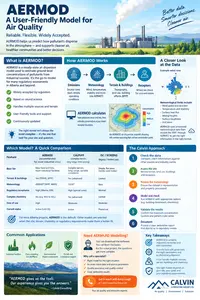

What Does a Certified Regulatory and Compliance Professional Need to Know?
For air-quality work, the skill set spans several disciplines.
Atmospheric science, Understand meteorology, atmospheric stability, turbulence, mixing and the behaviour of pollutants.
Emissions science, Understand how emissions are generated, measured, estimated and reported.
Modelling, Understand the strengths, limitations and appropriate applications of AERMOD, CALPUFF, AERflare, ABflare and related tools.
Geography and GIS, Understand terrain, land use, receptors and the physical layout of industrial facilities.
Regulation, Understand the applicable legislation, approvals, guidelines and regulator expectations.
- In Alberta, this can involve the Environmental Protection and Enhancement Act, the Alberta Air Quality Model Guideline, Alberta Ambient Air Quality Objectives and Guidelines, and, for applicable oil-and-gas flaring and incineration assessments, AER Directive 60. Directive 56 and individual approval conditions may also become relevant depending on the project.
- For projects in British Columbia, Calvin also works with BC requirements, including applicable waste-discharge permits and provincial modelling guidance.
The ability to find the applicable requirement is itself a professional skill.
Communication, A technically correct result is not very useful if nobody can understand what it means. Reports have to work for technical reviewers, regulators, engineers, managers and other decision-makers.
Professional judgement, This is the part that is hardest to put into a checklist. It comes from technical knowledge, experience, review, discussion, mistakes, investigation and learning.
Do you have concerns about air pollution in your area??
Perhaps modelling air pollution will provide the answers to your question.
That is what I do on a full-time basis. Find out if it is necessary for your project.
Have your Say...
on the StuffintheAir facebook page
Other topics listed in these guides:
The Stuff-in-the-Air Site Map
And,
Thank you to my research and writing assistants, and the author remains responsible for the content.
A Professional Modeller's Checklist
Before the model runs:
☐ Is the regulatory or technical question clearly defined?
☐ Is the project scope clear?
☐ Are the emissions sources complete?
☐ Are emission rates defensible?
☐ Are the operating scenarios complete?
☐ Is the meteorology appropriate?
☐ Does the terrain representation make sense?
☐ Are receptors located where they need to be?
☐ Are buildings represented accurately?
☐ Is the selected model appropriate?
After the model runs:
☐ Does the maximum occur where you would expect?
☐ Do the results respond sensibly when important inputs change?
☐ Are unusual results explainable?
☐ Are the averaging periods correct?
☐ Do the results make physical sense?
☐ Can another modeller understand and reproduce the approach?
☐ Does the conclusion actually follow from the analysis?
That's what makes a Certified Regulatory and Compliance Professional valuable in air-quality work.
---
A Career in Air Quality Modelling
If you enjoy science but don't want to spend your entire career doing the same kind of calculation, air-quality modelling can combine:
- physics;
- chemistry;
- meteorology;
- mathematics;
- computer modelling;
- GIS;
- engineering;
- environmental regulation; and
- technical writing.
You might spend one day investigating a strange dispersion result and another reviewing emissions from a new facility. You might work with a regulator, an engineer, a plant operator and a client project manager on the same assessment.
The work is technical, but it is also investigative. You have to be comfortable saying: I don't think that number makes sense. Let's find out why.
That attitude is often more valuable than knowing another software command.
Most Popular Pages on this Website:
Pictures of Global Warming
- See photos, cartoons, charts, graphs and a few surprises.
Clouds
- Don't know a cumulus from a stratus? Check here.
Causes of Global Warming
- It's not always obvious.
Calgary Alberta Weather
- Example of Canadian Goodness.
Thermometers
- Our favourite weather instrument.
- Home
- Contact Us
- Free E-zine Back Issues
- Privacy Policy
- Site Map - I'll help find something good.

By Barry Lough, P.Met., EP (Environmental Professional)
Text copyright © 2003-2026 Stuff in the Air.com
BACK TO TOP - Hit your 'Home' Key