- Air Homepage
- Air Quality Modelling Service
- Air Quality Testing
- Air Dispersion Model
Which air dispersion model should you use?
Choosing an air dispersion model sounds like a software question. It really starts with a different question: What are you trying to find out about the air?
A model is a mathematical description of how pollutants move and disperse after they are released. Give it emissions, meteorology, terrain, buildings and receptors and it can estimate concentrations at locations where people or the environment could be affected.
That sounds straightforward. The interesting part is deciding which representation of the atmosphere is appropriate.
At Calvin Consulting Group, AERMOD is the model we choose most often for conventional industrial dispersion modelling. That experience covers past projects in Alberta, Saskatchewan and British Columbia as well as work in Ontario, New Brunswick, Quebec and internationally. CALPUFF remains an important tool when the atmosphere or the regulatory question calls for it. Other models have specialized roles.
The best air dispersion model is therefore the one that represents the important features of the problem without adding complexity that does not improve the answer. That is a judgement call.
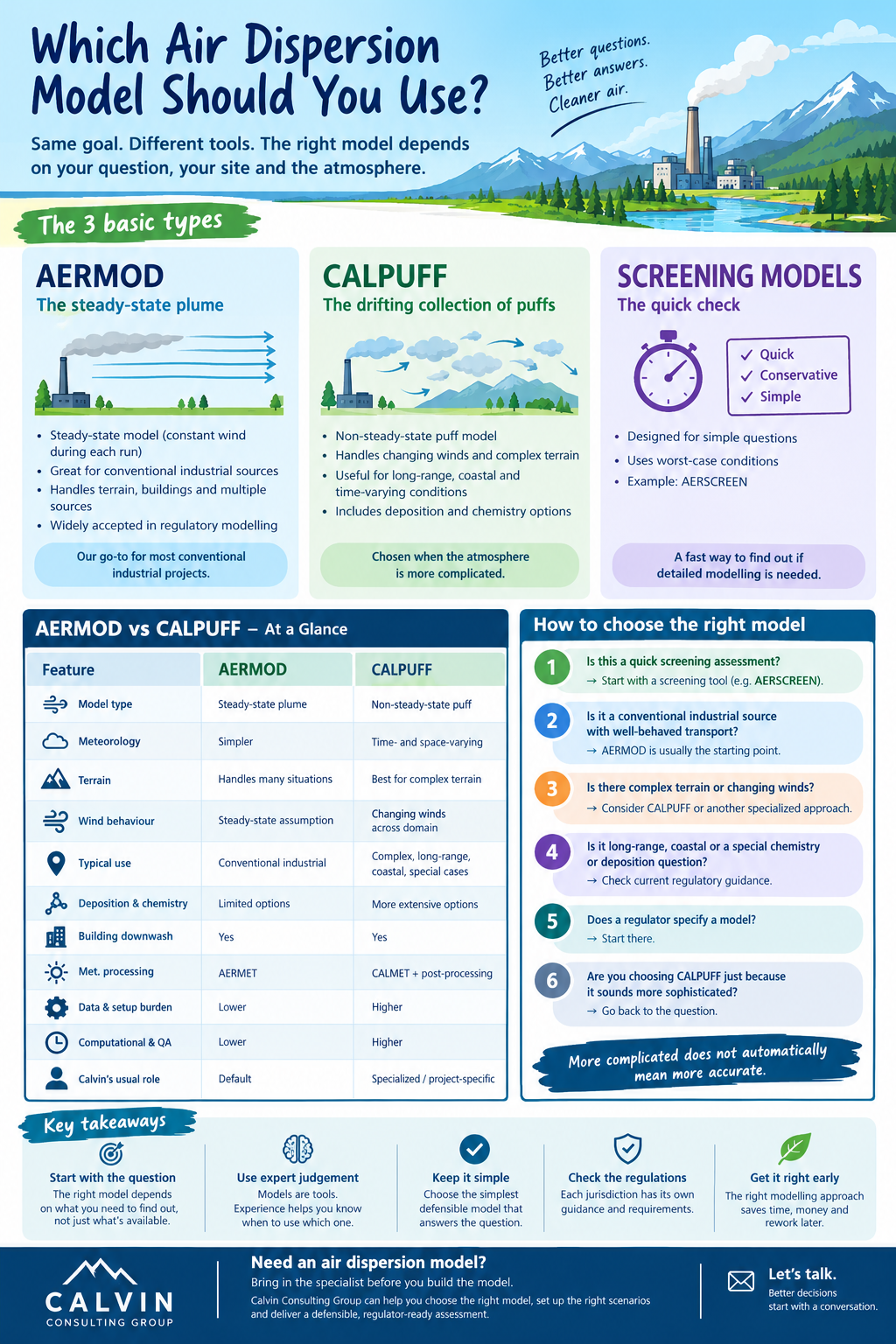
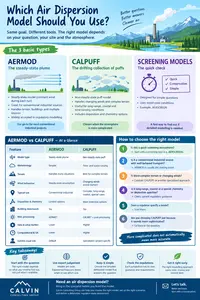
The three basic kinds of air dispersion model
It helps to think about models in plain English before getting into software names.
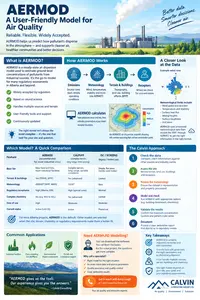
AERMOD: the moving-air snapshot - AERMOD is a steady-state plume model.
Imagine releasing smoke from an industrial stack while the wind blows steadily. AERMOD represents the plume as it travels downwind and spreads through the atmosphere under the prevailing meteorological conditions.
That makes it particularly useful for conventional industrial sources where the important atmospheric behaviour can be represented with relatively straightforward meteorology.
AERMOD can handle multiple sources, building downwash, terrain, different emission rates and many of the features required for regulatory modelling. Alberta currently recommends AERMOD-PRIME for refined assessments. Saskatchewan also lists AERMOD among its approved standard and specialized models. BC's modelling guidance recommends AERMOD for situations where a straight-line, steady-state approach is appropriate.
CALPUFF: the drifting collection of puffs - CALPUFF takes a different approach.
Instead of treating the plume as a continuously advancing steady-state plume, it represents the release as a sequence of puffs that travel through meteorological fields that can change with time and location. That becomes useful when the wind changes substantially across the modelling area.
Picture a plume moving through mountains. The wind in one valley can behave very differently from the wind a few kilometres away. A plume can curve, split, encounter terrain or move through changing atmospheric conditions. This is where a CALPUFF-based air dispersion model can represent behaviour that a simpler steady-state approach may not capture adequately.
CALPUFF also has capabilities for deposition, chemical transformation and other applications where a more detailed treatment of transport is useful. Alberta recognizes CALPUFF as a re`fined modelling option and BC's guidance identifies it for complex flow and time- and space-varying meteorology.
Screening models: the quick question - There is another category worth knowing about.
A screening model is designed to answer a relatively simple question: Is this problem obviously small enough that detailed modelling may not be necessary?
AERSCREEN is one example. It is designed to make conservative screening assessments using worst-case meteorological conditions.
Screening and refined modelling serve different purposes. A quick screening calculation can be extremely useful at the beginning of a project. Running a more complicated model simply because it looks more impressive is a poor use of time.
AERMOD vs CALPUFF
Here is the practical comparison.
Question
AERMOD
CALPUFF
Basic idea
Steady-state plume
Non-steady-state puff
Meteorology
Relatively straightforward representation
Time- and space-varying meteorological fields
Typical industrial application
Excellent fit for many conventional facilities
Useful when transport conditions are more complicated
Terrain
Handles many terrain situations
Particularly useful where terrain strongly affects flow
Wind behaviour
Assumes conditions can be represented using a steady-state framework
Can represent changing wind direction and speed across the modelling domain
Long-range applications
Often appropriate depending on the regulatory framework and assessment
Can be used where long-range transport or other special circumstances justify it
Deposition
Available capabilities
Stronger role in specialized applications involving deposition
Chemistry
Selected secondary-pollutant methods and options
More extensive capabilities depending on configuration
Building downwash
Yes
Yes
Meteorological preparation
AERMET and related processing
Usually requires CALMET plus CALPUFF and post-processing
Data and setup burden
Generally lower
Generally higher
Computational and QA burden
Generally lower
Generally higher
Calvin's usual role
Default for conventional industrial work
Specialized or project-specific applications
The important row is near the bottom. More complicated does not automatically mean more accurate.
The extra machinery of a CALPUFF air dispersion model only helps when the extra machinery represents something important about the real problem. That is the central idea behind model selection.
Why AERMOD is usually the starting point
For most conventional industrial projects, there is a good reason to start with AERMOD.
It is widely accepted in regulatory modelling. It has mature methods for industrial point, volume and area sources. It handles building downwash through PRIME. It can work with terrain and detailed receptor networks. It is supported by established meteorological preprocessing tools and regulatory guidance.
Just as important, experienced modellers know what to expect from it. Calvin uses AERMOD routinely in Alberta, Saskatchewan and British Columbia. We have also used it for projects in Ontario, New Brunswick, Quebec and internationally.
That does not mean AERMOD wins every modelling argument. It means the default should be based on the physical problem rather than on the apparent sophistication of the software.
A current regulator can always require or accept a different approach. The modelling plan, applicable guidance and project circumstances still matter.
The EPA's own current framework makes the same larger point: it distinguishes preferred or recommended models, alternative models and screening tools rather than treating every model as interchangeable. CALPUFF is now listed as an alternative model in the EPA system.
When is CALPUFF worth the extra work?
CALPUFF becomes attractive when the atmosphere itself is complicated enough that a steady-state plume may leave out something important. For example:
Complex terrain - Mountains are an obvious example. But there are mountains nearby is not automatically a CALPUFF decision.
The real question is whether the terrain creates atmospheric flow patterns that materially affect the pollutant transport. A flat-topped ridge several kilometres away may matter much less than a narrow valley that channels the wind directly through the project area.
Strongly changing winds - AERMOD is based on a steady-state treatment for each meteorological condition. CALPUFF can represent a plume moving through changing wind fields.
That can matter in areas where wind direction and speed vary substantially over the modelling domain.
Coastal and shoreline environments - Sea-breeze and land-breeze circulations can create changing wind patterns that are difficult to represent with a simple straight-line mental picture.
BC's modelling guideline specifically identifies coastal situations among applications where CALPUFF may be appropriate.
Long-range transport - Distance matters, but it is easy to make this issue more complicated than it needs to be.
The old statement that EPA recommends CALPUFF for transport over 50 km should be retired from our mental toolboxes.
EPA removed CALPUFF from its preferred-model list for long-range transport in 2017. Its current framework uses a screening approach for long-range transport and treats CALPUFF as an alternative model for appropriate applications.
So the modern question is: What modelling approach does the regulatory framework require or support for this particular long-range assessment? That is much more useful than memorizing a distance threshold.
Deposition and specialized atmospheric processes - CALPUFF can be useful when the assessment requires treatment of wet or dry deposition, chemical transformation or other processes beyond a basic primary-pollutant concentration calculation.
That still does not make it the universal solution. A specialist may decide that another model is better suited to a particular chemical or process.
What about ADMS, CMAQ, ISC and SCREEN3?
There is a temptation to make a model-selection article into a giant catalogue of software. That usually makes it less useful.
ADMS is a serious modelling system with specialized applications. At Calvin, it has been useful for specialty work such as carbon-capture-related modelling involving amines and nitrosamines.
That is a different problem from selecting the default model for an ordinary industrial stack.
CMAQ is a sophisticated chemical transport model designed for regional air-quality applications and atmospheric chemistry. Calvin has not needed to use CMAQ to date.
That is worth saying plainly. A modeller does not gain credibility by pretending to have used every atmospheric model ever invented.
ISC and SCREEN3 ISC3 is largely a historical footnote for modern regulatory work.
SCREEN3 (derived from ISC3) is also mainly of historical interest compared with modern screening tools such as AERSCREEN.
Software evolves. Regulations evolve. The fact that a model once mattered does not mean it belongs in today's workflow.
That history is still interesting, especially if you are studying the development of air dispersion models, but it should not distract from the practical decision facing a current project.
The hidden workload behind CALPUFF
This is where the choice becomes more interesting. A CALPUFF project is more than run CALPUFF. The system normally involves several stages, including meteorological-field generation with CALMET, CALPUFF itself and post-processing.
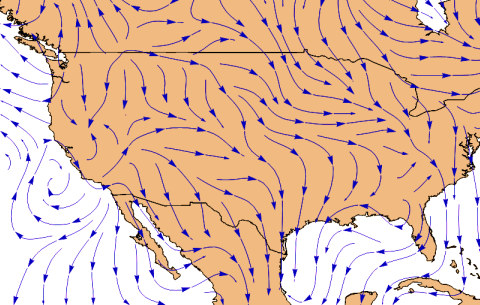
CALMET can create a detailed wind field across a modelling domain using observations and other meteorological information. Its calculations can account for terrain effects and other features of atmospheric flow.
That extra capability is precisely why CALPUFF can be useful. It is also why it creates more opportunities for poor assumptions, inappropriate inputs and quality-control problems.
An air dispersion model can produce beautifully detailed maps while still producing an answer that is poorly supported.
The more elaborate the model, the more carefully the modeller needs to understand what is happening inside it.
The challenge: choosing the right amount of reality
Every model is a simplification. The atmosphere is three-dimensional, turbulent, chaotic and constantly changing. A model turns that mess into equations. That is its strength.
The danger is forgetting that the equations are a representation of reality rather than reality itself.
A good model gives you useful predictions that can be tested against measurements, physical expectations or regulatory requirements. A bad modelling exercise can produce thousands of pages of output and still answer the wrong question.
That leads to one of the most useful rules in modelling: Don't start with the model. Start with the question.
Ask: What decision will this modelling support?
Then ask: What atmospheric behaviour could change that decision?
Then choose the model that represents that behaviour adequately. This sounds almost painfully obvious. It is also one of the easiest parts of modelling to get backwards.
A simple model-selection decision tree
Here is the practical version.
- Do you need a quick screening assessment? → Start with a screening tool such as AERSCREEN where applicable.
- Is this a conventional industrial source with reasonably well-behaved transport? → AERMOD is usually the starting point.
- Is complex terrain creating complicated airflow? → Investigate whether CALPUFF or another specialized approach is justified.
- Are wind conditions strongly variable across the modelling domain? → Consider CALPUFF or another model capable of representing that variation.
- Is the assessment regional or long-range? → Check the current regulatory approach before selecting the model.
- Are deposition, atmospheric chemistry or secondary pollutants central to the question? → Determine whether AERMOD, CALPUFF or a specialized chemical transport model is appropriate.
- Does a regulator, permit or modelling guideline specify an approach? → Start there.
- Are you choosing CALPUFF simply because it sounds more sophisticated? → Stop and go back to the question.
What an experienced modeller notices
Model selection gets much easier once you have seen enough projects to recognize the traps. Here are a few.
Mountains do not automatically mean CALPUFF: Terrain is important because of what it does to atmospheric flow.
The largest emission rate does not automatically produce the largest ground-level concentration: Stack height, exit velocity, temperature, buoyancy and building downwash can all affect plume behaviour.
A very high release rate may produce a strongly buoyant plume that rises substantially before reaching the ground. Another operating condition with a lower emission rate can occasionally produce a higher ground-level concentration.
That is one reason scenario selection deserves as much attention as software selection.
A model can run perfectly and still be addressing the wrong question: The computer does not know whether the scenario you gave it represents the actual operating condition of interest. It will cheerfully calculate whatever you ask.
More receptors do not fix a bad model: A million receptor points cannot compensate for inappropriate meteorology, poor source characterization or the wrong modelling approach.
More sophistication creates more places to make mistakes: A complex modelling chain requires more preprocessing, more assumptions and more quality assurance.
That does not make complex modelling undesirable. It means complexity should earn its keep.
Flare modelling is a useful exception
Calvin does use CALPUFF in an important specialized application: flare modelling.
Alberta's ABflare system uses CALPUFF as part of its modelling workflow. Flare assessments can involve complicated scenarios including steady flaring and blowdowns.
Flare modelling also demonstrates why the highest emission rate equals highest concentration idea can be misleading. Flare behaviour depends on stack geometry, gas composition, heating value, exit conditions, combustion efficiency, buoyancy and other parameters. Blowdown scenarios can introduce changing release rates over time.
In practical work, Calvin may use AERflare and ABflare to evaluate alternative stack heights, diameters and supplemental fuel requirements.
That can turn the modelling exercise into a design exercise. A model might show that a taller stack improves dispersion. Another configuration might require less fuel but create different exit conditions.
The goal is to find a defensible combination of design, emissions and atmospheric behaviour that satisfies the applicable requirements without adding unnecessary cost.
That is a good example of where choosing the right air dispersion model is only the beginning of the job.
Can you do the modelling yourself?
For learning purposes, absolutely. Running an air dispersion model can be an excellent way to understand meteorology, atmospheric physics and environmental regulation.
A simple exercise can teach you a great deal about plume rise, wind direction, stability, terrain and source strength.
Regulatory modelling is a different proposition. The difficult decisions often happen before the model runs:
- Which sources matter?
- Which operating scenarios should be assessed?
- Is AERMOD adequate?
- Does CALPUFF actually add useful information?
- Which meteorological data are representative?
- Which receptors matter?
- How should buildings be represented?
- What background concentration should be used?
- Which regulatory objectives apply?
- Does the result make physical sense?
A person can become very good at operating modelling software without becoming good at answering those questions. That distinction matters.
Early modelling decisions can save a lot of rework
One of the most expensive modelling mistakes is choosing the approach after the project has already been built around the wrong assumptions. By then you may have:
- collected the wrong data
- built the wrong receptor grid
- prepared the wrong meteorology
- modelled the wrong scenarios
- explained the wrong regulatory comparison to the client
- discovered halfway through that a specialized model is needed
Starting with a specialist review can be much cheaper than rebuilding a modelling study later.
At Calvin Consulting, we often get involved before the model is run. That gives us an opportunity to question the source data, operating scenarios, terrain, buildings, meteorology and regulatory requirements before they become expensive modelling inputs.
It also gives the project team a chance to decide whether the simplest defensible approach is sufficient. That is usually a better investment than buying a sophisticated answer to an irrelevant question.
The Calvin approach
Our starting point is straightforward: Use the simplest defensible model that answers the question.
For conventional industrial work, that usually means AERMOD.
When conditions justify something more specialized, we investigate the alternatives. That can include CALPUFF, ADMS or other specialized tools depending on the problem.
For flare applications, Calvin also works with AERflare and ABflare, including CALPUFF-based modelling workflows.
Our experience across Alberta, Saskatchewan, British Columbia and other jurisdictions helps us recognize when an apparently complicated problem is actually quite manageable, and when a seemingly simple problem contains a trap.
The objective is not to use the fanciest model. It is to produce a result that can survive technical review, regulatory scrutiny and common sense.
The point of choosing an air dispersion model
A good air dispersion model does not eliminate uncertainty. It organizes uncertainty into something that can be calculated, examined and discussed.
AERMOD is an excellent general-purpose regulatory tool. CALPUFF remains useful when changing meteorology, complex terrain, long-range transport or specialized atmospheric processes justify its additional machinery. ADMS and other models have their own specialized applications.
The trick is knowing which problem you actually have. The model is only one part of the answer.
The professional judgement behind the model may be the more important part.
Need an air dispersion model?
You can download the software and start learning how it works. For a regulatory project, the more valuable question is whether you are setting up the right model in the first place.
Calvin Consulting Group can review a proposed modelling approach, help define the scenarios and inputs, select the appropriate model and carry the work through to a defensible regulatory assessment.
Getting that guidance early can save considerably more time and money than discovering halfway through the project that the original modelling approach needs to be rebuilt.
When the modelling decision matters, bring in the modeller before you build the model. Need help with this? Visit our website or reach Barry by email at:

Clean air is our Passion...Regulatory Compliance is our Business.
This US government webpage has free modeling software: https://www.epa.gov/scram/air-quality-dispersion-modeling-preferred-and-recommended-models - but it takes quite a bit of effort to learn.
More ideas for
air dispersion model users...
Can you do it better?
You like this Idea? It works for its intended purpose, but probably is not perfect. Why not?
Do you know of a better one? We'd all like to see it, I'll bet. A penny for your thoughts.
Other people and their ideas...
Click below to see hi-tech contributions from other visitors to this page...

Vanadis 
3D unsteady state Eulerian type model with convection.
There is the equation that was solved (description is in polish :)
https://www.feazone.org/readarticle.php?arti …

CALPUFF Training Not rated yet
TRC Engineering and TRC Solutions are listed on the NYSE as TRR. TRC Solutions' Atmospheric Studies Group (ASG) puts on CALPUFF courses sometimes.
…

Air Pollution Air Quality Air Dispersion Not rated yet
Air is the most important element of our human environment. Man cannot live much more than a single moment without air. But we often do not think it is …

Feedback Not rated yet
I just went through this...really all the points which came to my mind are covered by you. No more additions are needed. If you bring this to practise, …
CALPUFF air Not rated yet
Using dispersion method, you are purifying the air. I think it is the best idea, but the contaminants of this purified air should concern.
Barry's …

Benefits of the use of calpuff air model Not rated yet
I have no idea what we are writing about here. This article makes no sense and I have learned nothing from it.
I have never heard of any of these …
MY THINKING Not rated yet
Why do you model for air quality?? What is important and what models do you use?
Barry's Response - The most popular choice for a long time was …
calpuff air Not rated yet
I agree that the steady-state model would not be great when used for distances extending greater than a few kilometres. And that more advanced models such …
Go back from Air Dispersion Model to the Air Quality Testers web page, or visit the Stuff in the Air homepage.
Search this site for more information now.
Recent Articles


-
Energy and Environment: Persuading industry to care
Sep 15, 26 02:47 PM
 What's wrong with Alberta's energy and environment? International media criticize the province and its biggest industry almost every day. Here's the truth.
 -
AERMOD Air Quality Modelling in Alberta
Sep 14, 26 05:58 PM
 Can you tell me which air quality model works best for most Alberta Air Quality Model Guideline regulatory modeling? AERMOD. It's easy, versatile, and recognizable.
 -
Air Dispersion Model - What's an air model?
Sep 14, 26 02:13 PM
How do we help a factory control air pollution? Provide design feedback ahead of time using an air dispersion model.

What modelling actually requires
The software is only one piece of the work. A defensible assessment normally requires decisions about:
- emission rates and operating scenarios
- source geometry
- stack height and diameter
- exit temperature and velocity
- building dimensions and locations
- terrain
- receptor locations
- meteorological data
- background concentrations
- chemical treatment where applicable
- model version and options
- averaging periods
- regulatory objectives
- cumulative or baseline conditions
- quality assurance
- interpretation of the results
This is why Can I download the software? is rarely the most useful question. Of course you can download software.
The harder part is knowing what to put into it.
Do you have concerns about air pollution in your area??
Perhaps modelling air pollution will provide the answers to your question.
That is what I do on a full-time basis. Find out if it is necessary for your project.
Have your Say...
on the StuffintheAir facebook page
Other topics listed in these guides:
The Stuff-in-the-Air Site Map
And,
Thank you to my research and writing assistants, and the author remains responsible for the content.
Air dispersion model selection checklist
Before starting a modelling project, ask:
About the question
- What decision will the modelling support?
- What pollutant or pollutants matter?
- What averaging periods matter?
- Which operating conditions need to be represented?
About the facility
- What are the emission sources?
- What are the physical source parameters?
- Are buildings close enough to affect the plume?
- Is there unusual terrain?
- Are emissions steady or highly variable?
About the atmosphere
- Is the wind reasonably well represented by a steady-state approach?
- Could terrain produce complicated flow?
- Are there strong spatial or temporal changes in wind conditions?
- Is long-range transport relevant?
About regulation
- Which jurisdiction applies?
- What modelling guidance applies?
- Is a particular model recommended or required?
- Is an alternative-model justification needed?
About the result
- Does the model represent the important physics?
- Are the assumptions defensible?
- Does the result make physical sense?
- Can someone independently understand and challenge the calculation?
If those questions are answered before the software is opened, the modelling project is already in much better shape.

By Barry Lough, P.Met., EP (Environmental Professional)
Text copyright © 2003-2026 Stuff in the Air.com
BACK TO TOP - Hit your 'Home' Key