- Air Homepage
- Air Quality Modelling Service
- Environmental Social and Governance
- Different Types of Air Pollution
What Different Types of Air Pollution Do You Actually Need to Model?
Before starting, the real challenge is deciding what actually needs to be modelled to get an industrial emissions approval. Industrial facilities don't have just a single emission rate. Emissions change during normal operations, maximum production, start-ups, shutdowns, flaring, maintenance, upsets and temporary operating conditions. The modeller's job is to determine which different types of air pollution scenarios matter, which ones regulators expect to see and whether the emissions being modeled actually represent the facility.
The model will calculate whatever you tell it to calculate, but it cannot tell you whether the inputs are realistic. A technically perfect model can still answer the wrong question.
Experienced modelling therefore starts with understanding the process:
- industrial operations, followed by
- emissions
- atmospheric dispersion
- predicted concentrations and then
- regulatory decisions.
One of the fastest ways I find problems in a modelling assessment is to compare the emission scenario against how the facility actually operates. If the model assumes every source operates at its highest output simultaneously, the first question is whether the facility can physically operate that way.
The key question is always, What is actually being released? A flare, for example, might represent combustion products or an uncombusted atmospheric release and those are entirely different modelling problems. The goal is not just to run the model, but to ensure the scenario being modelled is the one that actually matters for approval.
 Wow! Watch the shifting plume
Air emissions modelling starts with a question: which operating condition could create the facility's worst air-quality impact?
Before any approval application, the modeller must understand what is being released, where, how much, for how long and under what conditions. Different types of air pollution cases can all produce different emissions and different air-quality risks.
A model like AERMOD or CALPUFF cannot determine whether the scenario is realistic. That's why experienced modelling begins by asking:
- What is actually being released,
- can sources operate simultaneously,
- what happens during start-up, shutdown, flaring or upset conditions and
- what does the regulator need this assessment to demonstrate?
The key to approval is ensuring the right scenarios are modelled in the first place.
Types, Impacts and Alternatives to Air Pollution
This page is for anyone navigating industrial air-quality approvals. It's especially valuable if you're:
- planning a new facility or expansion,
- renewing or amending an approval,
- increasing production capacity,
- adding combustion equipment or a flare,
- dealing with an upset or temporary authorization,
- assessing whether existing modelling is still valid or
- responding to a regulator's request for additional modelling.
In each case, the key question is the same: have the operating conditions that drive air emissions been properly identified, assessed and demonstrated for approval?
Air Quality Modelling Across Western Canada: Same Goal, Different Emphases...
British Columbia, Alberta and Saskatchewan all require air quality assessments to demonstrate that a facility can operate without causing unacceptable impacts on ambient air quality. Regardless of province, the foundation is the same:
- develop representative emission scenarios,
- model pollutant dispersion under realistic meteorological conditions,
- evaluate compliance with air quality objectives and
- document the assumptions, inputs and results in a defensible manner.
Beyond Smog: Understanding Air Pollution in British Columbia
British Columbia places particular emphasis on how emissions vary over time. Facilities are expected to assess both short-term and long-term operating conditions.
 Variability in BC's emission rates
BC recognizes that worst-case impacts do not always occur at maximum production. Reduced operating loads can sometimes increase ground-level concentrations because plume rise decreases or emission characteristics change. As a result, screening analyses often examine multiple operating capacities, such as 25%, 50%, 75% and 100% load, to determine the true worst-case scenario.
The province also encourages assessment of startup and shutdown conditions and allows actual emissions data to be used when reconstructing historical events. The key message is simple: accurate modelling requires understanding how emissions change over time.
Impact of Alberta's Facilities on the Air
Alberta focuses heavily on identifying and modelling the different types of air pollution scenarios most relevant to regulatory approvals. Assessments for new facilities, amendments and renewals typically evaluate:
- Normal operation
- Maximum operation
- Startup
- Shutdown
- Flaring
- Upsets
- Emergency releases
- Cumulative effects
- Temporary operating conditions
The central question is not simply "What are the emissions?" but rather "Which combinations of sources and operating conditions could realistically occur together?"
The Alberta Guideline requires a set of emission rates. Where highest emissions differ significantly from routine operations, separate modelling scenarios may be required. Annual averages are generally based on typical operating conditions, while short-term assessments often focus on maximum foreseeable releases.
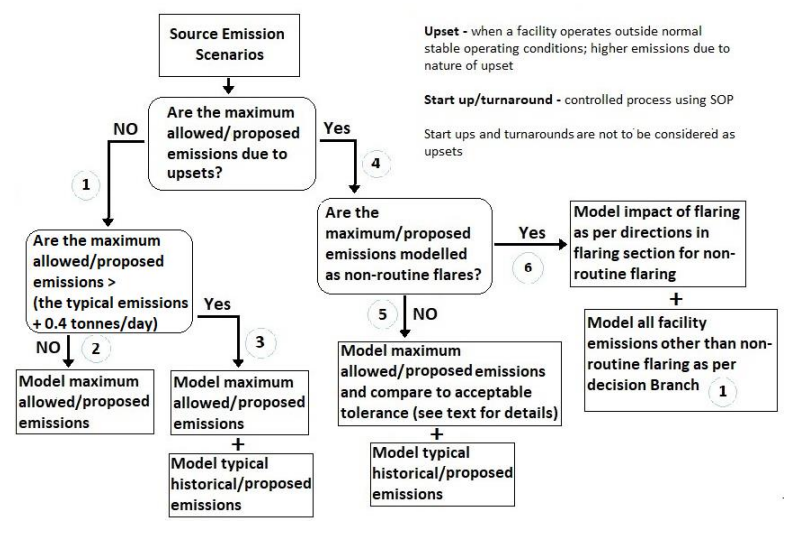 This chart addresses different types of air pollution for new applications, renewals and amendments.
The province also provides detailed guidance on flaring, upset emissions, cumulative effects and the distinction between routine and non-routine flaring, making Alberta's framework particularly comprehensive for industrial facilities.
Different Types of Air Pollution Affecting Saskatchewan Skies
Saskatchewan takes a straightforward and practical approach. Air quality assessments generally assume all significant operations are running simultaneously to provide a conservative estimate of potential impacts.
 Decision-making and the environment
The province requires consideration of routine operating emissions, startup and shutdown conditions, emergency releases as well as malfunctions
However, Saskatchewan also admits that not every scenario requires detailed modelling. If startup, shutdown or intermittent emissions are infrequent and unlikely to materially increase concentrations, additional modelling may not be necessary.
Particular attention is given to emergency and malfunction scenarios for facilities located near communities, where high short-term emissions could affect nearby receptors.
All three provinces are ultimately trying to answer the same question: Under realistic operating conditions, will the facility meet air quality requirements and protect the surrounding environment?
Air Quality Dispersion Modelling: Key Operating Conditions and Assessment Criteria
Operating condition
Why it matters
Typical treatment
What determines whether it needs modelling?
Normal operation
Represents routine exposure
Normally modelled
Routine operating emissions and applicable approval requirements
Maximum operation
May produce highest short-term concentrations
Normally modelled
Whether maximum emissions represent a credible operating condition
Startup
Emissions may differ from normal operation
Case-specific
Magnitude, duration, frequency and potential impact
Shutdown
Can produce unusual emissions
Case-specific
Whether emissions materially differ from normal operation
Flaring
Potentially high short-term emissions
Case-specific
Flare rate, duration, composition and regulatory context
Upset/ malfunction
Can produce very high emissions
Case-specific
Nature and credibility of the event, duration and regulatory treatment
Emergency release
Short-duration high emissions
Case-specific
Release magnitude, duration, receptors and regulatory requirements
Temporary operation
May be central to an authorization
Often modelled
Whether it forms part of the proposed authorization
Cumulative sources
Determines total ambient impact
Where applicable
Whether other sources materially contribute to predicted concentrations
This summary of different types of air pollution is to serve as a concise guide to key air quality modelling requirements for industry, consultants and regulators.
Can the Facility Operate Safely and Meet Air Quality Limits?
Air quality assessments are essentially a roadmap for predicting how a facility may affect local air quality under different operating conditions.
An emissions and dispersion modelling report typically documents emission rates, operating scenarios and the assumptions used in the assessment. Using models such as AERMOD, predicted pollutant concentrations are calculated from emissions, meteorology and terrain data, then compared against applicable air quality objectives. The results help regulators and operators understand potential impacts, identify risks and determine whether additional controls or mitigation measures are needed.
In short, air quality modelling answers a simple question: under a wide range of conditions, can the facility operate while meeting air quality requirements and protecting the surrounding environment?
Are the results believable? Validation is more than checking that the software worked. A modeller should ask whether the maximum occurs where it should, whether the concentration pattern looks realistic and whether changes in inputs produce the expected response. For example does a higher stack temperature increase plume rise and can a lower flow rate actually increase ground-level concentrations by reducing plume rise?
The results should also be examined in the context of meteorology, source design and engineering judgment. Are unusual exceedances tied to specific weather conditions? Does changing the source configuration produce a plausible shift in concentrations? Are the results consistent with engineering expectations? Most importantly, if something looks wrong, is the anomaly caused by the model, the inputs or the underlying physics?
Get expert air quality modeling for your industrial needs with...
Calvin Consulting Group Ltd.
Planning a new facility, modifying an existing one or responding to a regulatory request? Calvin Consulting helps clients determine what actually needs to be modelled before spending money on unnecessary work.
With more than 30 years of experience, our team has helped industrial clients across Canada obtain approvals, maintain compliance and understand the real air quality impacts of their operations. We model more than just normal operations, evaluating startups, shutdowns, flaring, upsets and other scenarios that can influence regulatory outcomes.
Our strength is practical expertise. We have conducted complex assessments for industry, supported regulators and trained government agencies. Whether you need a new air quality assessment, an approval amendment or a review of previous work, we provide clear, defensible analyses and concise reports that help move projects like yours forward.
Just as importantly, we often find that additional modelling is not required. Sometimes a revised emission scenario is sufficient. Sometimes an existing assessment already answers the regulatory question. The first step is determining which situation applies to your facility.
Before commissioning more modelling, let's determine whether you actually need it. Contact Calvin Consulting for an air quality assessment review or consultation.

Clean air is our Passion...Regulatory Compliance is our Business.
When additional modelling may not be necessary Not every regulatory question requires a new dispersion model run.
- the existing assessment already represents the proposed change;
- the emission scenario has changed but remains bounded by an existing modelled scenario;
- the proposed modification does not materially change the dispersion characteristics;
- engineering calculations can demonstrate that the scenario is insignificant;
- the regulator's question can be answered from existing results.
This is one of the first things we check before recommending additional modelling.
We'll tell you when you don't need us.
Recent Articles


-
Energy and Environment: Persuading industry to care
Sep 15, 26 02:47 PM
 What's wrong with Alberta's energy and environment? International media criticize the province and its biggest industry almost every day. Here's the truth.
 -
AERMOD Air Quality Modelling in Alberta
Sep 14, 26 05:58 PM
 Can you tell me which air quality model works best for most Alberta Air Quality Model Guideline regulatory modeling? AERMOD. It's easy, versatile, and recognizable.
 -
Air Dispersion Model - What's an air model?
Sep 14, 26 02:13 PM
How do we help a factory control air pollution? Provide design feedback ahead of time using an air dispersion model.
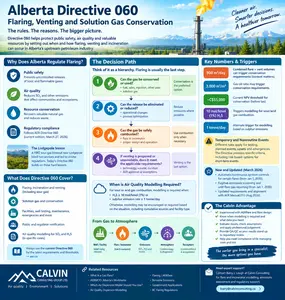
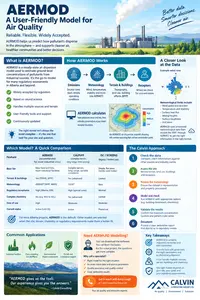
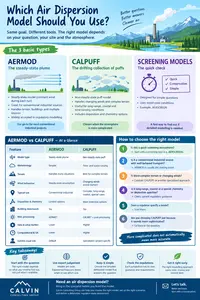
What exactly is happening at the facility, and does the model represent it?
Before accepting a model result, I look at:
1. Emissions
Do the rates correspond to the actual operating scenario?
2. Stack parameters
Do the height, diameter, temperature and velocity match the engineering information?
3. Buildings
Are downwash and release geometry represented correctly?
4. Meteorology
Is the dataset representative?
5. Receptors
Could the grid miss the maximum?
6. Neighbours
Are important existing sources included?
7. Results
Does the spatial pattern make physical sense?
8. Scenario logic
Does the scenario actually represent something the facility can do?
9. Regulatory question
Does the model answer what the regulator is asking?
Industrial facilities don't have one emission rate. They have operating states. The modelling-challenge is determining which states matter. States such as:
- Normal
- Maximum
- Startup
- Shutdown
- Flaring
- Upset
- Temporary operation
Do you have concerns about air pollution in your area??
Perhaps modelling air pollution will provide the answers to your question.
That is what I do on a full-time basis. Find out if it is necessary for your project.
Have your Say...
on the StuffintheAir facebook page
Other topics listed in these guides:
The Stuff-in-the-Air Site Map
And,
Thank you to my research and writing assistants, and the author remains responsible for the content.
Quick modelling checklist
Before requesting or approving an air-quality assessment, check:
□ Facility configuration confirmed
□ Emission sources identified
□ Maximum and typical rates established
□ Operating hours confirmed
□ Flare rates and durations confirmed
□ Gas composition confirmed
□ Stack parameters confirmed
□ Building dimensions confirmed
□ Meteorological data reviewed
□ Terrain and land use reviewed
□ Receptors appropriate
□ Background concentrations established
□ Neighbouring sources considered
□ Modelling scenarios agreed
□ Regulatory objectives identified
□ Existing modelling reviewed
□ Regulatory expectations confirmed
Most Popular Pages on this Website:
Pictures of Global Warming
- See photos, cartoons, charts, graphs and a few surprises.
Clouds
- Don't know a cumulus from a stratus? Check here.
Causes of Global Warming
- It's not always obvious.
Calgary Alberta Weather
- Example of Canadian Goodness.
Thermometers
- Our favourite weather instrument.
- Home
- Contact Us
- Free E-zine Back Issues
- Privacy Policy
- Site Map - I'll help find something good.

By Barry Lough, P.Met., EP (Environmental Professional)
Text copyright © 2003-2026 Stuff in the Air.com
BACK TO TOP - Hit your 'Home' Key