- Air Homepage
- Air Quality Modelling Service
- Air Quality Modeling
- Numerical Weather Prediction NWP Models
How Numerical Weather Prediction NWP Models Power Accurate Air Dispersion Studies
In air quality dispersion modelling, your assessment is only as reliable as your meteorological data. Missing surface observations, a lack of upper-air soundings, or unmonitored complex terrain can halt a regulatory approval in its tracks. And Numerical Weather Prediction NWP models, such as the Weather Research and Forecasting (WRF) model, have transformed environmental assessments.
By blending prognostic weather fields with real-world observations, modellers can generate precise, regulatory-compliant meteorological inputs for AERMOD and CALPUFF, even in the most remote industrial corridors.
The Core Challenge: Missing Data & Complex Terrain
Regulatory agencies across Western Canada enforce strict meteorological quality standards before an air dispersion model is accepted for EPEA, OGC or Environmental Assessment filings:
 Assessing air quality today
- The 90% Completeness Rule: Continuous hourly surface data must generally meet or exceed 90% completeness per quarter and year.
- The Upper-Air Gap: Physical radiosonde (balloon sounding) stations are sparse. AERMET and CALMET require vertical atmospheric profiles to calculate mixing heights and boundary layer turbulence accurately.
- Terrain Masking: Surface stations located in valley bottoms often miss regional wind shears, slope flows and temperature inversions over adjacent complex terrain.
When on-site monitoring is incomplete or non-existent, NWP output processed via MMIF (Mesoscale Model Interface Program) fills these critical gaps without forcing project proponents into years of costly monitoring delays.
Western Canada Meteorological Regulatory Matrix for numerical weather prediction NWP models
Each western province governs the use of numerical weather prediction NWP models and modelled meteorology under distinct guidelines. The table below summarizes the accepted approaches for refined modeling (AERMOD / CALPUFF):
Integrating NWP into AERMET and CALMET: The Technical Workflow
Province
Primary Regulatory Guideline
Minimum Data Period
Accepted NWP / Pre-Processed Datasets
Key Met Modelling Requirement
Alberta
Alberta Air Quality Model Guideline (AQMG)
1 Yr (On-site ) or 5 Yrs (Regional)
AEPA 5-Year Pre-Extracted Datasets; WRF/NWP
AEPA regional dataset is standard unless site-specific ground data is justified; must handle calm wind conditions using approved flags.
British Columbia
BC Air Quality Dispersion Modelling Guideline
1 Yr (Site-Specific) or 3–5 Yrs (Regional/ NWP)
WRF / MMIF output for AERMET/ CALMET; MSC stations
Level 2/3 assessments in complex terrain favor hybrid CALMET runs combining NWP initial guess fields with surface observations.
Saskatchewan
SK Air Quality Modelling Guideline
1 Yr (On-site) or 5 Yrs (Regional)
Ministry 5-Year Regional Datasets (WRF-derived)
Regional datasets derived via WRF/AERMET are available across 5 provincial zones; custom surface roughness requires MMIF runs.
Manitoba
MB Air Dispersion Modelling Guideline
1 Yr (High-Quality) or 5 Yrs (Consecutive)
Environment Canada (MSC); Representative NWP
Data gaps require formal impact discussions in the final report; screening defaults available for simple Level 1 reviews.
 It's not quite this strict in Alberta
Senior Modeller's Note: Raw NWP output cannot be fed directly into AERMOD or CALPUFF. It requires specialized preprocessing to extract parameter fields, align spatial grids and format surface and upper-air files.
1. Processing for AERMOD (AERMET & MMIF)
Parameter Extraction: MMIF (another in the list of numerical weather prediction NWP models) extracts surface parameters (sensible heat flux, friction velocity , Monin-Obukhov length) and upper-air profiles directly from WRF grid cells.
Calm Hours & Low Wind Speeds: AERMET's low-wind options (ADJ_U*) must be evaluated carefully when processing NWP data to prevent over-predicting ground-level peak concentrations during stagnant nighttime conditions.
2. Processing for CALPUFF (CALMET Grid Models)
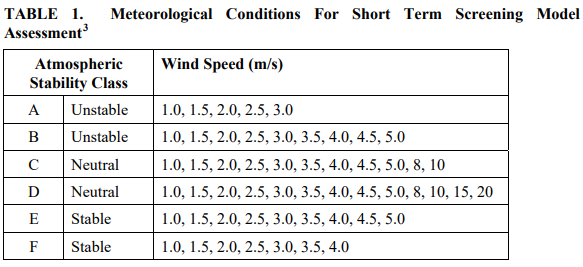 Screening Data: Pasquill-Gifford Stability and Velocity
- Step 1 Wind Field (Initial Guess): NWP model output serves as the Step 1 wind field in CALMET, providing fine-scale kinematic terrain effects, slope flows and blocking effects.
- Step 2 Diagnostic Adjustments: Observational surface data are blended into the Step 1 field using defined radii of influence (R1, R2) and barrier parameters to ensure real-world observations anchor the prognostic model.
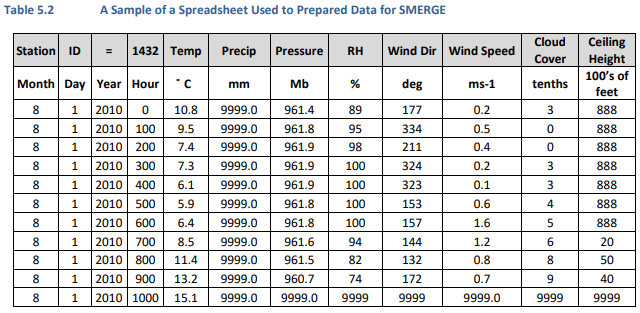 An example of a table used to prepare CALMET data
Why Leading Operators Partner with Calvin Consulting
Navigating regional meteorological requirements shouldn't delay your project approval.
 Vancouver air quality forecast looks good
With over 30 years of specialized air quality experience across Western Canada, Calvin Consulting Group Ltd. bridges the gap between complex atmospheric science and regulatory success.
Agency-Trained Experts: Our senior modellers have audited assessments and trained regulatory personnel across Alberta, BC, Saskatchewan and Manitoba.
Turnkey Met Data Processing: We extract, QA/QC and process high-resolution WRF, MMIF, AERMET and CALMET datasets tailored specifically to your facility's terrain.
Defensible Submissions: We deliver clear, concise Air Quality Assessment Reports (AQAR) designed to pass regulatory audits on the first review.
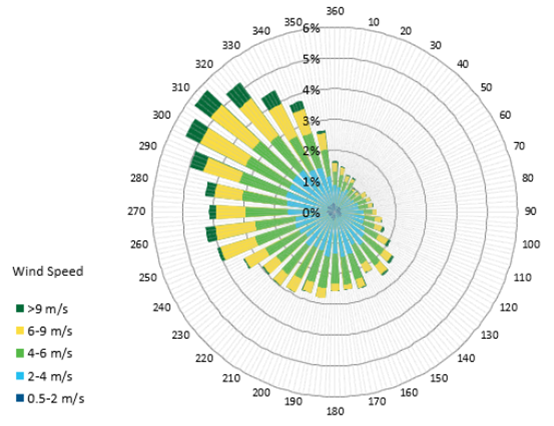 Graph the weather data
Ready to Resolve Your Meteorological Data Requirements?
Don't let missing weather data hold back your environmental permit. Contact Barry Lough or the technical team at Calvin Consulting Group today to discuss your site-specific modelling plan.

We'll handle the air quality details so you can focus on your business.
Clean air is our Passion...Regulatory Compliance is our Business.
Recent Articles


-
Computers in Meteorology | How Would they Help You?
Sep 26, 26 09:40 PM
 Computers in meteorology help us keep track of atmospheric data and make predictions.
 -
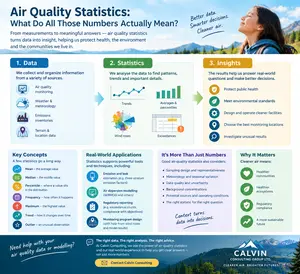
Air Quality Statistics: What Do All Those Numbers Actually Mean?
Sep 21, 26 12:00 AM
 How are air quality statistics used to understand pollution, design monitoring programs, estimate emissions and make environmental decisions?
 -
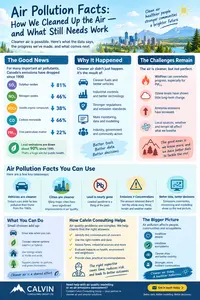
Surprising Air Pollution Facts: It's Not All Bad News!
Sep 17, 26 06:14 PM
 Trying to improve air quality has been a priority. Here are some air pollution facts to show you how far we've come.

The Numerical Weather Prediction NWP model is refining air quality and how we conduct dispersion modelling.
Models like these simulate weather conditions, so they're great for environmental assessments, especially in areas where empirical data is sparse. When combined with observational meteorological data, they take us towards greater accuracy in our regulatory air dispersion studies.
Data interpolation or similar data substitutes are needed when we have gaps in on-site meteorological data. NWP models help us deal with problems posed by complex terrain and stagnant air. Making reliable, science-backed environmental decisions can start with understanding numerical weather prediction NWP models.
Do you have concerns about air pollution in your area??
Perhaps modelling air pollution will provide the answers to your question.
That is what I do on a full-time basis. Find out if it is necessary for your project.
Have your Say...
on the StuffintheAir facebook page
Other topics listed in these guides:
The Stuff-in-the-Air Site Map
And,
Thank you to my research and writing assistants, and the author remains responsible for the content.
Most Popular Pages on this Website:
Pictures of Global Warming
- See photos, cartoons, charts, graphs and a few surprises.
Clouds
- Don't know a cumulus from a stratus? Check here.
Causes of Global Warming
- It's not always obvious.
Calgary Alberta Weather
- Example of Canadian Goodness.
Thermometers
- Our favourite weather instrument.
- Home
- Contact Us
- Free E-zine Back Issues
- Privacy Policy
- Site Map - I'll help find something good.

By Barry Lough, P.Met., EP (Environmental Professional)
Text copyright © 2003-2026 Stuff in the Air.com
BACK TO TOP - Hit your 'Home' Key