Testing PH of Houshold Liquids
by Cara
(Florida)


Scientific PH meter
Atmospheric Secrets: The Sky Detective's Guide - Ever wonder if the rain in your backyard is a chemical soup or a secret code? We're about to outsmart the experts and find out what's hiding in the sky.
Cara says: I remember doing a project as a child with the help of my mother.With some 9-volt batteries and that probably came packaged together with instructions, we built a very basic pH meter. From there, we used the meter to test various objects of my choosing.
It was exciting for me to try to hypothesize about what liquids would be acidic or basic! I had so much fun sticking my little meter into different liquids and recording the data.
Later, I made some very basic charts demonstrating the most acidic to most basic liquids. I completed a short paper to describe acids, bases, and why knowing about them would be valuable. In the end, I did an oral presentation on my work. The project was a success, and I even went to some sort of regional science fair with children from other schools.
The Reward
Completing a science project was such a great experience. I remember being so scared at first, as it seemed like such a daunting task. But, once I realized you could break things down into different steps, and work on one step at a time, it made things much easier and more manageable.This is a lesson that is helpful throughout day to day life, which I learned from a science fair experiment! The task gave me confidence, as I showed myself not only was I able to master the project, but also to successfully explain it to others. It also made me realize that it’s good to be curious, and that learning is fun!
I definitely feel that children can benefit from science fairs and experiments. It’s a fun break from the standard textbook learning that goes on, and it teaches skills that are beneficial in areas well outside of science.
Barry's Response - Couldn't have said it better myself, Cara. Thanks for your story. I'm sure many will enjoy it.
Search this site for more information now.
What we do when the sky's sour
Don't trust the experts to tell you if the world is ending. Let's try it out with a 9-volt battery and some wires. Testing PH of household liquids isn't just a chore; you're training to be a detective.It's because people want to touch science. It proves a kid can win a science fair with a homemade tool in the text above. Let's expand on this. If you can test lemon juice, you can test raindrops. When you test a raindrop, you get a seat at the table in the huge debate over Acid Rain and Ocean Acidification.
Squeeze of the Science
The pH measures the power of hydrogen. When it rains, water falls through the air and scrubs it. The rain turns acidic if there's sulphur in the air. This is often screamed as a disaster by mainstream science. Let's take a look at the math.There's fluctuation in nature. More sulfur was pumped into the sky before humans built a single car. There's a buffer system on the Earth. Apparently we're supposed to be stewards of the earth, not slaves or destroyers. Data is essential for stewardship. You're just guessing if you don't test the pH.
It's a sassy counter-narrative
We should all panic because the ocean is acidifying. Let's calculate the scale. Oceans are actually basic (around 8.1). Even if it drops to 8.0, it's still basic. The word acidification makes you feel like the sea is turning into vinegar. No, it's not.Don't let their adjectives scare you. Make sure you use your meter.
Front porch air quality
Here's where my air quality consulting meets your kitchen table. We calculate how smoke particles change the soil chemistry when they move from a wildfire or factory. Maybe it's not the dirt causing your garden soil to have a funky pH.Here is a Rebellious Invention - What's the point of testing? Make a vortex collector. Use a funnel instead of a flat bucket. Centrifugal force (physics!) separates heavy dirt from water before it hits your meter.
Science belongs to everyone, not just scientists. The pH meter is your best friend, and doesn't care about your leanings. There's no political party there. There are only numbers on it.
What you need to know
- Math is music: pH scales are logarithmic. A jump from pH 4 to pH 3 isn't one more - it's ten times more acidic. One click turns it from a whisper to a rock concert. By the way, the decibel scale works the same way.
- We give you the data, you decide what it means. Don't let a computer model in a basement 3,000 miles away be the only thing that tells you what's going on.
- Rainwater harvesting is life or death in India and Africa. Their survival technology could be your greatest science project.
Comments for Testing PH of Houshold Liquids
|
||
|
||
|
||
|
||
|
||
|
||
|
||

Recent Articles


-
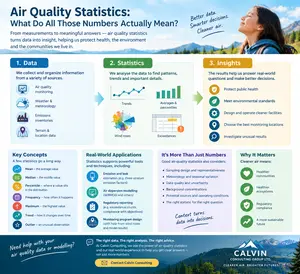
Air Quality Statistics: What Do All Those Numbers Actually Mean?
Sep 21, 26 12:00 AM
 How are air quality statistics used to understand pollution, design monitoring programs, estimate emissions and make environmental decisions?
 -
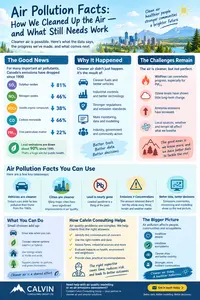
Surprising Air Pollution Facts: It's Not All Bad News!
Sep 17, 26 06:14 PM
 Trying to improve air quality has been a priority. Here are some air pollution facts to show you how far we've come.
 -
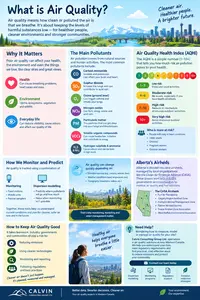
What is air quality and how can we fix it?
Sep 16, 26 11:19 AM
What is air quality? How do you define good air quality? It's just the opposite of air pollution.
Do you have concerns about air pollution in your area??
Perhaps modelling air pollution will provide the answers to your question.
That is what I do on a full-time basis. Find out if it is necessary for your project.
Have your Say...
on the StuffintheAir facebook page
Other topics listed in these guides:
The Stuff-in-the-Air Site Map
And,
Thank you to my research and writing assistants, and the author remains responsible for the content.
Most Popular Pages on this Website:
Pictures of Global Warming
- See photos, cartoons, charts, graphs and a few surprises.
Clouds
- Don't know a cumulus from a stratus? Check here.
Causes of Global Warming
- It's not always obvious.
Calgary Alberta Weather
- Example of Canadian Goodness.
Thermometers
- Our favourite weather instrument.
- Home
- Contact Us
- Free E-zine Back Issues
- Privacy Policy
- Site Map - I'll help find something good.

By Barry Lough, P.Met., EP (Environmental Professional)
Text copyright © 2003-2024 Stuff in the Air.com
BACK TO TOP - Hit your 'Home' Key