The Menthos Myth?
by April
(Lilburn, GA)


A piece of the action
Menthos Myth: Launching a Soda Rocket and Defying Odds - All you need is a candy and some raw physics to make a ten-foot geyser out of a soda bottle. See how the same invisible forces that launch soda also create massive thunderstorms in our sky if you're tired of playing it safe.
April tells us this: In seventh grade I created a Science Fair project that wasn't very original, but it did get a lot of laughs. I came close to getting in trouble but I played ignorant.Did you know that the fizz created by a Menthos candy pebble, when placed inside a 2 liter soda bottle, actually causes some kind of chemical reaction? Well, it does!
I got together with two of my girlfriends and decided to do a very detailed experiment. The quality of of our graphs and research is what saved us from failing. The actual experiment conducted on school property was frowned upon.
If I had it to do over, I would have video-taped the various experiments and played them on a portable DVD player rather than let the explosion happen in the cafeteria. There wasn't an actual explosion, but a mess was made, nevertheless. The fact that putting the candy in the bottle caused a reaction and caused the fizz to burst through the top was very interesting to all the other kids in the class.
The science behind it impressed the teachers. What we did was got several types of soda and several types of candy. We monitored the insertion, the quantity of fizz that was created and the reaction if any.
I always had fun with science and by making learning fun, kids stay interested. You can apply science to everything in life. There is always an experiment to conduct if you put your mind to it.
Barry's Response - I've never done it myself, April, but it might be interesting.
Here, somebody had fun with it:
Search this site for more information now.
Soda Geysers and the Menthos Myth
Most people call this a chemical reaction. They're wrong. Let's look at nucleation.- Eruption physics Carbon dioxide is dissolved in soda (CO2). Water molecules surround this gas like a tight net. You're not starting a chemical fire when you drop a Mentos into the bottle; you're providing a type of landing strip for the gas.
- There are thousands of tiny pits called nucleation sites on Mentos candy.
- Surge: These pits let the CO2 form bubbles and surge upward with incredible speed.
- Result: The liquid erupts because the gas needs space now.
- Atmospherics (Meteorology & Air Quality) What does this have to do with our science project presentation? That's why our planet behaves like that soda bottle.
- As the cap keeps the fizz inside, atmospheric pressure controls how gases move.
- The Air Quality Reality: CO2 is often portrayed as the ultimate villain when it comes to climate change. Consider this: CO2 is life's fizz. Forests and oceans depend on it.
- Some skeptics argue that Earth, like a pressurized bottle, has natural valves like volcanic outgassing that manage these cycles. Is the planet actually exploding, or is it just breathing through a complex, well-designed system that we don't fully understand?
The Strategy for Winning Your Science Fair
Use this table to plan your experiment if you want to impress the judges:| Variable | The Action | The Resulting Force |
|---|---|---|
| Diet Soda | Removes the sticky sugar | The geyser soars higher. |
| Warm Soda | Increases molecular motion | The gas escapes faster. |
| Crushed Candy | Multiplies nucleation sites | The reaction accelerates instantly. |
Inventor's Tangent
When I heard someone tried this with sparkling mineral water to see if the natural bubbles reacted differently, they didn't. It reminded me of the aquatic environment skeptics who worry about ocean acidification. Nature buffers itself when we think of the ocean as a giant bottle of soda. It's not about living in fear of a "pop"; it's about respecting the pressure and keeping the cap clean (i.e., our environment).Global Geyser: Expanding the Narrative
Don't just talk about candy if you want to revolutionize this project. Let's talk about aerosols. We study how tiny particles in the air cause clouds to form. They're just like Mentos! For water vapor to turn into rain, they provide nucleation sites.A world in a grain of sand / And a heaven in a wildflower — William Blake
Imagine what dust from a desert or salt from the sea does to our weather if a candy can launches soda ten feet in the air. It's not just a mess; you're modelling the physics of thunderstorms.
Get in on the Rebellion
Do you think settled science ignores the fun and chaos of nature? Could CO2 be the Earth's version of extra fizz?Let me know what you think! What would you launch into the atmosphere to change the weather? Please, don't say more soda - the janitors are already mad.
Comments for The Menthos Myth?
|
||
|
||
|
||
|
||


Recent Articles


-
Natural Gas Leak Detection: Does YOUR Facility Need it?
Sep 28, 26 08:40 AM
 It's important for industries, especially in the energy sector, to have a natural gas leak detection program. It's often required by law.
 -
Computers in Meteorology | How Would they Help You?
Sep 26, 26 09:40 PM
 Computers in meteorology help us keep track of atmospheric data and make predictions.
 -
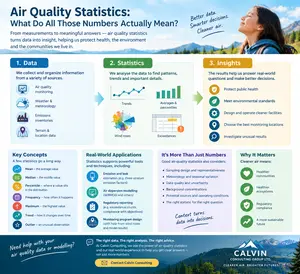
Air Quality Statistics: What Do All Those Numbers Actually Mean?
Sep 21, 26 12:00 AM
 How are air quality statistics used to understand pollution, design monitoring programs, estimate emissions and make environmental decisions?

Do you have concerns about air pollution in your area??
Perhaps modelling air pollution will provide the answers to your question.
That is what I do on a full-time basis. Find out if it is necessary for your project.
Have your Say...
on the StuffintheAir facebook page
Other topics listed in these guides:
The Stuff-in-the-Air Site Map
And,
Thank you to my research and writing assistants, and the author remains responsible for the content.
Most Popular Pages on this Website:
Pictures of Global Warming
- See photos, cartoons, charts, graphs and a few surprises.
Clouds
- Don't know a cumulus from a stratus? Check here.
Causes of Global Warming
- It's not always obvious.
Calgary Alberta Weather
- Example of Canadian Goodness.
Thermometers
- Our favourite weather instrument.
- Home
- Contact Us
- Free E-zine Back Issues
- Privacy Policy
- Site Map - I'll help find something good.

By Barry Lough, P.Met., EP (Environmental Professional)
Text copyright © 2003-2024 Stuff in the Air.com
BACK TO TOP - Hit your 'Home' Key