Weather or air quality jobs
by Holly
(Canada)


Consulting the weather chart
Doubt, Dreams, and Direction in Choosing Your Weather - There are times when a single story hits you right where you live. People wrestle with dreams, second thoughts, and the strange thrill of discovering who they are becoming—and their honesty might pull you in too.
Holly brings up a good point or two: How should I decide between weather or air quality jobs? I was wondering about your consulting job. HOw did you get into that, and did you enjoy it? I am deciding between being a weather girl or consultant myself. Any advice would be appreciated, as i am not sure who even to ask about this. I have been talking to the Josh Classen of CFRN CTV Edmonton news, he is the main weather man there. Again, any advice or knowledge would be apprciated.Barry's Response - I take it you are a student in meteorology or some similar field, coming at a crossroads of some sort and not sure what to go with.
When I finished my studies in the early '90's, jobs of any kind were scarce enough that I worked in completly non-scientific fields (such as 7-Eleven) for a couple of years and jumped at the very first relevant job that came my way.
This was with a consulting company named Jacques Whitford who has a large air quality group in their Calgary office. It meant moving down from Edmonton myself and setting up here. I guess you could say I sort of fell into it. This company is quite good for the fresh graduate as they get plenty of varied experience needed to make intelligent career decisions. I understand they are hiring again.
Expect to work long hours at times.
I eventually left this position to pursue an operational career in meteorology with Environment Canada, after their 10-year hiring freeze was lifted. It turned out not my bag.
There have been times when I wished I had gone the TV weather person route. Any established station will want you to have credentials such as a degree in communications, with meteorology coming in second, so it seems. I found this out from Claire Martin, a former classmate of mine who has been doing weather on Global & CBC.
She and I were "fans" of Bill Matheson, who had the post way back then.
I guess what I'm really saying is, nobody but you can find your direction, but you probably knew that already. It took me several air quality jobs and such, and I still don't know if I'm there yet.
Reassuring? I doubt it, but good luck anyway. The adventure is worth it.
Search this site for more information now.
Getting Your Place Between Sky and Smoke
Choosing between weather and air quality jobs feels like arguing with yourself on a windy ridge. The one side whispers, “Chase storms! ” while the other goes, "Model emissions like a boss and help people breathe." And yes, both voices sound dramatic because the atmosphere is dramatic. It combines heat, moisture, dust, wildfire plumes, and human dreams into one giant moving thing.You're not alone if you're confused about meteorology and air quality. Even scientists with decades of experience wander through both worlds before settling down. Even the atmosphere wanders. Temperature inversions flip the script, and sometimes the weather acts like a teenager.
Let's break down what happens behind each door before you decide.
Weather Door - Forecasting, TV, Radar Rooms, and the Ancient Art of Trying
Work on the weather moves fast. There's a race between the synoptic systems. Dropped data. The models fight. Like reading faces, you learn to read the sky. You turn pressure fields into meaning. Stage left is taken over by a warm front. Forecasting attracts people who like:- Decisions in real time
- Getting pumped
- Pressure
- Taking it in stride
- Trying to explain science to people who are upset about rain
There's also a quiet spiritual thread to operational meteorology. The world makes sense to you when you see patterns. Creation breathes. Chaos and order share a balcony. It's not something everyone says out loud, but it's something many feel.
Modeling, regulations, chemistry, and slow, high-stakes thinking
Working in air quality requires patience, detail, and an almost sacred respect for the invisible. Air quality unfolds slowly, unlike forecasting where storms race. Silently, emissions build up. Under the wind, plumes stretch like calligraphy. It might take tens of kilometers for a refinery leak to be noticed. Here's who you work with:- Models of dispersion (AERMOD, CALPUFF, ADMS)
- Chemistry of the atmosphere (NOx, SO2, H2S, VOCs, PM2.5, ozone precursors)
- Physics of boundary layers
- Inventory of emissions
- Regulations on the environment
- Politics with clients
- Concerns and anger from the public
Work matters. Helping communities breathe clean air, or telling a regulator, "Yes, that plant meets the limits," or honestly, "No, it doesn't" is powerful.
You don't have to choose - The Secret Third Door
There aren't two islands in atmospheric science. There's always a connection between weather and air quality:- Pollution gets trapped in temperature inversions.
- Smoke from wildfires blows into cities on sea breezes.
- Dispersion paths are shifted by pressure systems.
- Photochemistry and instability are both driven by solar radiation.
- Human health is linked to micrometeorology.
The Counter-Narrative Thread
Responsible, Science-Based, Free-Thinking... Lots of people say the atmosphere is collapsing or humanity is doomed. Some of them are scared, some are political, some are sincere. Atmospheric data tells a different story.Wildfires, urban heat, pollution, vulnerable ecosystems pose real risks. There are also a lot of improvements: lower SO2 across North America, declining lead, more precise models, real international treaties.
It's okay to hold two truths at once:
- Climate and air quality are affected by human activity.
- There are still cycles, oscillations, and surprises in nature (ENSO, QBO, AMO, solar variability).
What I said Fits This Story
My previous message gives students what they want:- Voices from the real world
- An actual career path
- Uncertainty is real Humor
- Reality is tough to bite sometimes
- Being honest about not knowing if you're there yet.
What's the best way to choose between weather and air quality?
Here's a test: If this fits you- Communication is awesome
- Maps, radar, and motion
- Want to warn people before it's too late
- then CONSIDER WEATHER but if you
- Love math, chemistry, and deep technical puzzles
- Measuring invisible stuff
- Want to share the air with industry and communities
- Stable, long-term work with room for innovation
- the CONSIDER AIR QUALITY
People who don't stick to one box often come up with the best ideas.
...And in the End...
It's important to study the sky and the air with courage, curiosity, and compassion, whether you chase storms or model plumes. You're asking the right questions if you're looking for weather or air quality jobs. We need free thinkers, quiet skeptics, creative scientists, and maybe a few rebels who can read clouds and still argue politely about dispersion coefficients.Leave a comment if you've walked either path or if you're still trying to figure it out. Maybe someone on that windy ridge needs your voice to steady them.
Comments for Weather or air quality jobs
|
||
|
||
|
||
|
||
|
||
|
||
|
||
|
||


Recent Articles


-
Natural Gas Leak Detection: Does YOUR Facility Need it?
Sep 28, 26 08:40 AM
 It's important for industries, especially in the energy sector, to have a natural gas leak detection program. It's often required by law.
 -
Computers in Meteorology | How Would they Help You?
Sep 26, 26 09:40 PM
 Computers in meteorology help us keep track of atmospheric data and make predictions.
 -
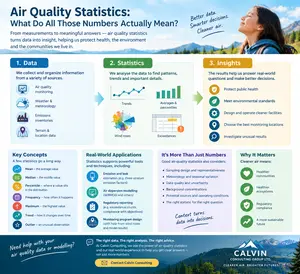
Air Quality Statistics: What Do All Those Numbers Actually Mean?
Sep 21, 26 12:00 AM
 How are air quality statistics used to understand pollution, design monitoring programs, estimate emissions and make environmental decisions?

Do you have concerns about air pollution in your area??
Perhaps modelling air pollution will provide the answers to your question.
That is what I do on a full-time basis. Find out if it is necessary for your project.
Have your Say...
on the StuffintheAir facebook page
Other topics listed in these guides:
The Stuff-in-the-Air Site Map
And,
Thank you to my research and writing assistants, and the author remains responsible for the content.
Most Popular Pages on this Website:
Pictures of Global Warming
- See photos, cartoons, charts, graphs and a few surprises.
Clouds
- Don't know a cumulus from a stratus? Check here.
Causes of Global Warming
- It's not always obvious.
Calgary Alberta Weather
- Example of Canadian Goodness.
Thermometers
- Our favourite weather instrument.
- Home
- Contact Us
- Free E-zine Back Issues
- Privacy Policy
- Site Map - I'll help find something good.

By Barry Lough, P.Met., EP (Environmental Professional)
Text copyright © 2003-2024 Stuff in the Air.com
BACK TO TOP - Hit your 'Home' Key