Ignorance Is NOT Bliss


Move over, please.
It's the new rebellion to think - Everyone tells you what to think about the environment, but no one shows you how. Maybe the real danger isn't pollution or climate change alone, but the moment we stop asking better questions?
What's Happening Here? Albert Einstein made the statement: "If honey bees become extinct, human society will follow in four years." Many people would be surprised to know that 90% of the feral (wild) bee population in the United States has died out... I really hope that my sister is right - that in a couple of years everything will be okay...Barry's Response - Okay, this sounds serious. First of all, what is happening? The wikipedia page on honeybee colony collapse disorder (CCD, https://en.wikipedia.org/wiki/Colony_collapse_disorder ) gives us some startling statistics summed up in this quote:
From 1972 to 2006, there was a dramatic reduction in the number of feral honey bees in the U.S. (now almost nonexistent) and a significant though somewhat gradual decline in the number of colonies maintained by beekeepers.
What has been causing this apparent extinction? Nobody knows for sure, but the wikipedia page points to several possible factors (disease/infestation, malnutrition, pesticides, changes in beekeeping practices, ambient radiation, winter-kill and genetically modified crops), and that each may make a small contribution to this situation leading to a synergistic effect. This is often the case with environmental problems.
What does it all mean? We can all imagine the disaster, going beyond having enough honey for your coffee & toast. Whole agricultural sectors have become aware of a possible threat to their existence. Pollination of fruit crops (which is free, by the way), could cease. Medical production could be knocked out of whack in a similar way.
What to do? The most likely solution may to revisit our use of pesticides, including removing those that threaten bees and introducing those that control organisms that threaten bees (except humans, I suppose). Conservation of their natural habitat should help also.
This is an area of study which shall gain greater attention going forward.
Search this site for more information now.
The bliss of ignorance isn't bliss
There's no one around. That's how it usually starts. Just fewer insects on the windshield, a thinner hum in summer air, a feeling that something slipped sideways.One villain gets blamed for everything. Capitalism, carbon, chemicals. Choose your monster.
Nature doesn't work like a courtroom. It's like the weather.
There's no side to the weather
Meteorology teaches you a hard lesson:- Real outcomes are rarely explained by one cause.
- Pressure shifts, so air moves.
- Heat redistributes, so storms grow.
- Turbulence mixes pollution, wind steers it, and sunlight transforms it.
- The sky isn't controlled by one knob.
We didn't read our politics to the bees
It's important because it exposes a pattern we repeat everywhere. Systems fail in layers, so Colony Collapse Disorder can't be pinned to one cause:- Colonies get weaker from parasites
- Nutrition is limited by monoculture farming
- Nervous systems are stressed by pesticides
- Extreme weather disrupts flowering
I don't think that's ideology. It's environmental science. Climate and air quality follow the same logic.
It doesn't matter who's right to air
There's no doubt about it when it comes to air pollution. Nitrogen oxide doesn't vote. Particulates don't remember. Sunshine reacts with precursors, no matter who released them. There's dispersion modeling because intent doesn't equal impact.It's still possible for good companies to do bad things. Sometimes bad actors don't matter as much as bad physics. It's uncomfortable for everyone, so slogans are safer than equations.
There's more to climate than one graph
This is where we can do some thinking. Infrared radiation is absorbed by greenhouse gases. It's solid physics. However, climate also responds to:- Heat storage and releasehttps://www.stuffintheair.com/WeatherMan.html in the ocean
- Variability in solar energy
- Models are still challenged by cloud dynamics
- Changes in land use that change albedo and moisture
Ignorance is the enemy, not business
Businesses pollute because they can. Some pollute because they don't know where their emissions go. That's why air-quality modeling matters -- not just for branding, but for humility.If you don't measure it, you can't fix it. It's boring to be responsible:
- Emissions quantified
- Dispersion is important
- Make sure your assumptions are right
- Operational adjustments
There's a strange overlap between left, right, and faith
Here's the part no one expects. We might be right about restraint, limits, and unintended consequences. Or maybe we're right about shared responsibility and long-term damage. Or both - stewardship says creation isn't disposable.There's no conflict between these ideas. Only when certainty replaces curiosity do they collide. There's no need for saviors for the environment. We need adults who aren't afraid to admit complexity.
It's not bliss to be ignorant, it's bliss to be clear
Denial and panic aren't good enough for young people. What they deserve is:- Uncertainty is okay
- Data from real people
- Permission to ask questions
- Instead of tribes, use tools
Good for you if that feels rebellious. It's always been about thinking.
It worked if it made you uncomfortable, curious, or quietly annoyed. Let me know what you think. Disagree sharply. You need to prove it. Get better at asking questions.
It's easy to be ignorant. It takes nerve to understand.
Comments for Ignorance Is NOT Bliss
|
||
|
||
|
||

Recent Articles


-
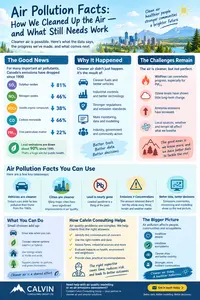
Surprising Air Pollution Facts: It's Not All Bad News!
Sep 17, 26 06:14 PM
 Trying to improve air quality has been a priority. Here are some air pollution facts to show you how far we've come.
 -
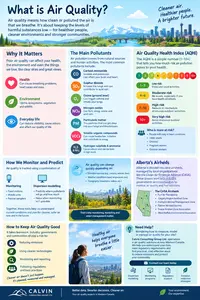
What is air quality and how can we fix it?
Sep 16, 26 11:19 AM
What is air quality? How do you define good air quality? It's just the opposite of air pollution. -
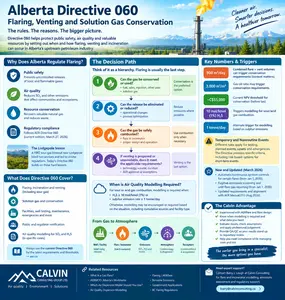
Energy and Environment: Persuading industry to care
Sep 15, 26 02:47 PM
 What's wrong with Alberta's energy and environment? International media criticize the province and its biggest industry almost every day. Here's the truth.
Do you have concerns about air pollution in your area??
Perhaps modelling air pollution will provide the answers to your question.
That is what I do on a full-time basis. Find out if it is necessary for your project.
Have your Say...
on the StuffintheAir facebook page
Other topics listed in these guides:
The Stuff-in-the-Air Site Map
And,
Thank you to my research and writing assistants, and the author remains responsible for the content.
Most Popular Pages on this Website:
Pictures of Global Warming
- See photos, cartoons, charts, graphs and a few surprises.
Clouds
- Don't know a cumulus from a stratus? Check here.
Causes of Global Warming
- It's not always obvious.
Calgary Alberta Weather
- Example of Canadian Goodness.
Thermometers
- Our favourite weather instrument.
- Home
- Contact Us
- Free E-zine Back Issues
- Privacy Policy
- Site Map - I'll help find something good.

By Barry Lough, P.Met., EP (Environmental Professional)
Text copyright © 2003-2024 Stuff in the Air.com
BACK TO TOP - Hit your 'Home' Key