Try As We Might....
by steve patterson
(barrie, ontario, canada)


Keeping our species alive
Face the big stuff with curiosity and courage - Sometimes we stumble into a conversation that makes the world seem huge and mysterious again. Their honesty might pull you deeper than you think when they talk about life, nature, loss, and the strange hope that still flickers when we talk about the future.
Steve says: Every day, at least one living organism becomes endangered or extinct. These, and their predecessors on the list of endangered and extinct species, did not become so overnight. There was obviously a build-up to this event, be it a fast or slow process, in the case of each individual species.As science has proven, there has been an unstoppable cycle of change within, on and around the planet Earth; changes so drastic that all life on the planet has ceased to exist for millions of years at a time.
Absolute annihilation of man-kind, as well as all other life forms on Earth, is inevitable. The disappearance of the species that have ceased to exist so far in our lifetime, is just the beginning of the process of elimination that will once again render the Earth lifeless.
There is nothing that can be done to stop this, or even delay the natural process that has been taking place since life began. Everything that lives, dies. Indeed, we can all grasp desperately to what is left of our time, as Earth's most proficient species, but the only thing that will truly be accomplished, is the mental comfort we may provide for ourselves along our journeys.
We can stand millions-strong for the sake of benevolence, but 'man' can not stop nature. We can not stop change.
Barry's Response - Hey Steve. This is like a really bad hangover. But worse. Thanks for your input.
Search this site for more evolutionary information now.
We'll try...
Your message hits like a thunderhead over an empty prairie. Nature swings between calm and catastrophe like a bored teenager flipping through radio stations. Rocks remember hotter times, colder times, wetter, drier, wilder times. Yes, species come and go. It's even in the air we breathe. Change is baked into the system, you're right.But here's the twist: the atmosphere never stops renegotiating its own future. Every second, it rearranges heat, water, dust, and sunlight. It tries stuff, fails, resets. Weather is the planet's way of making up its mind. We can't stop nature from shifting. But we don't have to act like cardboard cutouts.
There's a funny lesson in meteorology
...such as "small changes make a big difference."When you give a butterfly enough time and a hot tropical boundary, it can shift a storm track. A two-percent uncertainty in emissions can flip an entire regulatory conclusion. As the old saying goes, a mustard seed has potential that can move a mountain. We don't realize how much nature respects small inputs.
Yeah, the Earth has wiped itself clean before. Life keeps coming back like that kid in class who won't stop raising their hand. The life pushes back. We push back too. We've always done it.
Here's what makes people yell at dinner tables: Don't assume every shift in climate is our fault or that panic is the only moral response. Solar variations, ocean flips like ENSO (El Niño Southern Oscillation), volcanic curtains, orbital wiggles (i.e., Milankovitch Cycles) and other things make up the climate record.
Today's popular stories oversimplify that mess
It's just habit, not malice. We love simple villains. But that's not how nature works.That doesn't mean we should shrug. Science isn't the only thing that's old.
It doesn't matter if you want responsible resource use or environmental justice or both: we just want a world that keeps working. Air-quality science is one of the places where we make real progress, believe it or not. Better dispersion models, smarter regulations, local actions that actually improve health-these things work. There's no need for an apocalypse.
What about modern meteorology? From it, we get these superpowers:
- Hurricanes are spotted before they form.
- We map smoke before it hits the city.
- A century ago, cold snaps would've wiped out crops but we can now forewarn.
- Sometimes we succeed, sometimes we don't.
Even when we try... nature will win in the end. Meanwhile, we get to play, experiment, protect, question, improve, and sometimes even laugh at ourselves. It's not futility. Just participation, playing the game.
I hear the weight in your message, Steve. It's true. I also hear a hint of surrender I'm not ready for.
Our planet breathes, shifts, cracks, rebuilds... We're here to witness it somehow, We're measuring it, We're arguing about it, joking about it and that's not nothing.
Leave a comment if you have thoughts of your own
Or if you want to throw another curveball from the philosophical bleachers. I promise I'll bring both science and sass. Maybe even a weather chart.
Comments for Try As We Might....
|
||
|
||
|
||
|
||

Recent Articles


-
Natural Gas Leak Detection: Does YOUR Facility Need it?
Sep 28, 26 08:40 AM
 It's important for industries, especially in the energy sector, to have a natural gas leak detection program. It's often required by law.
 -
Computers in Meteorology | How Would they Help You?
Sep 26, 26 09:40 PM
 Computers in meteorology help us keep track of atmospheric data and make predictions.
 -
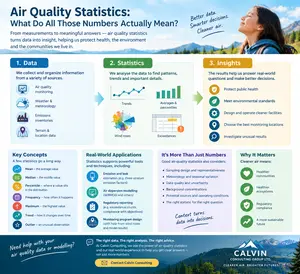
Air Quality Statistics: What Do All Those Numbers Actually Mean?
Sep 21, 26 12:00 AM
 How are air quality statistics used to understand pollution, design monitoring programs, estimate emissions and make environmental decisions?

Do you have concerns about air pollution in your area??
Perhaps modelling air pollution will provide the answers to your question.
That is what I do on a full-time basis. Find out if it is necessary for your project.
Have your Say...
on the StuffintheAir facebook page
Other topics listed in these guides:
The Stuff-in-the-Air Site Map
And,
Thank you to my research and writing assistants, and the author remains responsible for the content.
Most Popular Pages on this Website:
Pictures of Global Warming
- See photos, cartoons, charts, graphs and a few surprises.
Clouds
- Don't know a cumulus from a stratus? Check here.
Causes of Global Warming
- It's not always obvious.
Calgary Alberta Weather
- Example of Canadian Goodness.
Thermometers
- Our favourite weather instrument.
- Home
- Contact Us
- Free E-zine Back Issues
- Privacy Policy
- Site Map - I'll help find something good.

By Barry Lough, P.Met., EP (Environmental Professional)
Text copyright © 2003-2026 Stuff in the Air.com
BACK TO TOP - Hit your 'Home' Key