Water Erosion
by Susan Reid
(Rockport, IN)
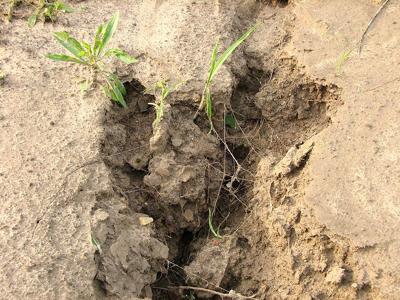

Soil eroded by running water
Dirt gets sucked up by water - Rain falls on a hill with grass and one without? Discover how nature teaches us science one muddy drop at a time by following the water and watching the soil move.
Start us off, Susan...I took a large, 30" x 18" translucent plastic tub and formed 2 large hills, one on each end of the box. I planted grass seed on one hill.Over the next 3 weeks I left it in the sun, watered it with a watering can each day, being sure to be equal in the watering process on each hill.
The end results showed erosion was heavier on the hill with no grass.
I didn't show as much erosion differences in the hills as I would have liked. I think, using sod on the one hill and leaving the other bare, would have achieved the results I wanted.
I love science. Growing up on a farm offered first hand experience on a daily basis.
Barry's Response - Susan, any difference at all would have made your point, I believe. Especially if you know you kept everything else equal for the two hills.
Water or wind can induce erosion in real life cases. This experiment examined the effects of water erosion, comparing the resistance of the two soil samples to removal by passing water. The differences in coverings can be expected to and actually do affect the amount of erosion caused by the water, given that all other conditions are identical.
This type of research can lead to solutions to problematic erosion, ways to impede the motion of soil and preserve the condition of the land. It's important.
To be most useful, such a study need to be scientific. Keep in mind that lab results are most meaningful if you have a control group (such as your bare hill) and are able to quantify the difference (perhaps measure the mass of the eroded soil in each case).
Search this site for more information now.
Soil heists and water erosion
Water steals silently. In a watering can, it looks peaceful, but on a bare hill, it's a liquid bulldozer. Susan tried modelling it in a plastic tub, but nature doesn't like simple boxes. The violence of a raindrop is the key to mastering your presentation on my science project.- Smash physics Raindrops act like mini bombs when they hit bare soil. 'Splash erosion' detaches soil particles, launching them into the air.
- Grass doesn't just sit there. A root's subterranean fabric grips the ground.
- Leaves intercept rain, stealing its kinetic energy before it hits the ground.
- Dust and meteorology You know Water Erosion is the father of air pollution if you work in air quality consulting. The sun bakes the remaining mud into dust when water scours the land. The wind takes over, lifting PM10 (coarse dust) into the air.
- We worry about car exhaust, but a poorly managed farm can choke a city just as much.
- Climate counter-narrative: Mainstream voices blame every mudslide on human-caused climate change. However, historical data shows that Earth has endured massive erosion cycles for millions of years. It didn't form because someone left their SUV idling; it formed because water has an ancient, relentless hunger.
- The difference between stewardship and control The Earth belongs to the Creator, and we're just the gardeners. This requires Stewardship, which is different from Environmentalism.
- We shouldn't be scared of the rain or the changing landscape, says the Skeptic.
- Landowners know their soil better than bureaucrats. More than a thousand glossy brochures, Susan's farm background taught her about aquatic environments.
- There's no question that preserving topsoil ensures that everyone can eat, rich or poor.
- The Smart-Soil Grid: A Revolutionary Proposal Don't just plant grass. We could engineer biodegradable 3D-printed lattices that mimic root structures. We could patch a hillside after a fire, preventing the mud from burying towns while the grass grows back. Drones can map the veins of a mountain and predict exactly where the water will strike.
The Expanded Response to Dominating Science Fairs
Barry's advice: Quantify the chaos if you want to win. Here's how it works:- Let's take your two hills. Let one grow sod (not just seeds) and leave the other naked.
- Use a needle-nose sprayer to mimic high-intensity rainfall instead of a watering can.
- Measure the runoff water in clear jars. You've got to let the mud settle. The dirt at the bottom of the jar tells the story.
When you challenge settled ideas, science thrives. Are all erosions disasters? Just ask the ancient Egyptians. As the Nile flooded and eroded the highlands, it brought rich, black silt to the valley. Without Water Erosion, the greatest civilization in history would have died. Creation and destruction are one and the same.
How do you feel about it?
Is it better to fight erosion with concrete and walls or let the Earth redecorate itself? Do you control your backyard, or does it just happen to be a wild beast?Let me know what you think! What's your wildest backyard washout story? Did you save the soil, or did the soil win? Let's talk grit.
Recent Articles


-
Ways to stop global warming
May 01, 26 08:28 PM
 The Great Car Debate - Depending on our choices, every car on the road could save the planet or slowly destroy it. Let's look at the facts and decide if
 -
Stop The Habits of SMOKING
Apr 30, 26 11:25 PM
Fresh Air and Clean Water - Just by uncovering a hidden poison, you could protect every fish in the ocean and every asthmatic. See how one tiny habit affects -
an idea
Apr 30, 26 12:29 AM
Trap the Gas - Each time someone starts a car, invisible gas pours into the sky, but what if we could catch it right at the tailpipe? Here's why a giant

Do you have concerns about air pollution in your area??
Perhaps modelling air pollution will provide the answers to your question.
That is what I do on a full-time basis. Find out if it is necessary for your project.
Have your Say...
on the StuffintheAir facebook page
Other topics listed in these guides:
The Stuff-in-the-Air Site Map
And,
Thank you to my research and writing assistants, ChatGPT and WordTune, as well as Wombo and others for the images.
OpenAI's large-scale language generation model (and others provided by Google and Meta), helped generate this text. As soon as draft language is generated, the author reviews, edits, and revises it to their own liking and is responsible for the content.
Most Popular Pages on this Website:
Pictures of Global Warming
- See photos, cartoons, charts, graphs and a few surprises.
Clouds
- Don't know a cumulus from a stratus? Check here.
Causes of Global Warming
- It's not always obvious.
Calgary Alberta Weather
- Example of Canadian Goodness.
Thermometers
- Our favourite weather instrument.
- Home
- Contact Us
- Free E-zine Back Issues
- Privacy Policy
- Site Map - I'll help find something good.

By Barry Lough, P.Met., EP (Environmental Professional)
Text copyright © 2003-2024 Stuff in the Air.com
BACK TO TOP - Hit your 'Home' Key