Water maker
by Alexis
(Allen Nebraska USA)


Heat, Plastic and Ice
Here's how to hack the planet and make your own rain - Do you ever feel like the adults are just guessing how the world works while you're stuck in the heat? Learn how to master the hidden science of light to build your own weather-bending future.
Alexis starts us off: All you have to do is get a black piece of trash bag or any other black wrap and then you have to get clear wrap.Then get three jars and fill them with 4 pieces of ice. On one jar put the black wrap, on another jar put the clear wrap and on the third jar leave it uncovered.
Put a heat lamp over it. On the first day do it for 5 minutes on the second day do it for 10 minutes and on the third day do it for 15 minutes to record which color makes the ice melt faster. Make sure each jar has a chance to be closest to the heat lamp.
Go Allen Eagles Science! If you have any questions email me at ssciencefactss@yahoo.com thank you :)
Barry's Response - Anybody care to guess what the results of this one would be?
All else being equal one would expect the principle of albedo to dictate the winner.
Reflect on this
We call the ability of a surface to reflect light energy its albedo. We calculate albedo by dividing reflected radiation by the incident (incoming) radiation. A value of zero indicates a totally dark surface where all energy is absorbed, while a '1' indicates total reflection, during which the temperature would not increase under any light intensity. Albedo also determines how well the object radiates energy.Furthermore, albedo is a function of the wavelength. So, while the object in question may completely absorb one set of wavelengths, it may reflect another. This is how all objects have a visible colour. It's also how something can reflect all visible light and absorb infrared or some other band.
In climatology, albedo takes a role in almost all assessments. For instance snow cover reflects nearly all incoming sunlight but radiates infrared quite well, thus keeping the locale colder than it would be if no snow were present.
Thank you for this inspiration, Alexis.
Search this site for more information now.
Ice and fire
Future world changers, listen up! You're already one step ahead of the people just waiting for rain if you're here to make water. It's not just melting ice in jars; we're playing with Earth's big knobs.Playing the Albedo Game
(Or: Why your black hoodie is a solar oven)Alexis gave us a killer experiment: three jars, some ice, a heat lamp, and some plastic wrap. It's easy, right? That's wrong. Albedo is the battle.
Think of Albedo as the politeness of a surface. A surface with an albedo of 1 reflects all incoming light back into space. 0 albedo surfaces are greedy black holes; they gobble up photons and turn them into heat.
- This is the rebel wrap. It absorbs the light, gets agitated (on a molecular level, it's literally dancing faster), and dumps the heat.
- It's like Invisalign for physics. Like a tiny greenhouse, it lets the light in, but traps the heat inside.
- Open Jar: Here's the control. The pure state, but it loses heat to the air.
Melting ice is a one-way ticket to doom, says mainstream science. As a Water Maker, you need to think critically. Does the Earth have a fragile glass ornament, or is it self-regulating?
When ice melts, it doesn't just disappear. It creates vapor. Clouds can form from high-altitude water vapor. How do clouds look? White. What's white's albedo? It's high! Melting ice (low albedo) creates clouds (high albedo), which reflect the sun and cool the Earth. It's a negative feedback loop. (Take your pick) God or nature built a thermostat that works. Science is never settled; it's a constant, rowdy debate. In the end, we'd still think the sun revolves around my ego (and while it's a big ego, the math doesn't add up).
Beyond the Jar: The Water Maker Revolution
What's the best way to expand this? Water can be made where there isn't any if we can control albedo.- What if we painted every road white in a desert city? Without a single air conditioner, we could drop the city's temperature by 10 degrees.
- We can use air quality data to see where dust (aerosols) is heating up the air, and use misting water makers to wash the air clean, changing local rain patterns.
Here's why you should care
You're not just passing a science fair if you master the Water Maker principles. You're learning how to protect your freedom. No one can tell you how to live, drive, or think if you understand the data yourself. You're the consultant. You're the inventor.How do you feel about it? Can the Earth's thermostat fix itself, or do we need to step in with Water Maker tech? Feel free to comment below - especially if you think I'm totally wrong. I love a good fight.
Can I design a blueprint for a DIY Albedo-Chiller you can build for under $20?
Recent Articles


-
Indoor Air Pollution | What are the Hidden Dangers?
Oct 16, 26 01:55 PM
 Do you have an indoor air pollution problem? Here's how to figure out where a basic problem might start.
 -
Air Pollution by Cars: Don't Breathe Too Deeply!
Oct 15, 26 03:07 PM
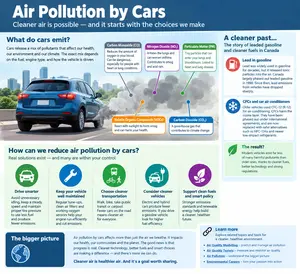
 Air pollution by cars is a big problem. Carbon monoxide is one of the major pollutants cars emit, but smarter use could reverse it.
 -
Environmental Impact Assessment: Work to do on air quality
Oct 14, 26 10:46 AM
 Before going ahead with industrial development, you need some research. The preliminary work would include an environmental impact assessment, market and economic analyses etc.
Do you have concerns about air pollution in your area??
Perhaps modelling air pollution will provide the answers to your question.
That is what I do on a full-time basis. Find out if it is necessary for your project.
Have your Say...
on the StuffintheAir facebook page
Other topics listed in these guides:
The Stuff-in-the-Air Site Map
And,
Thank you to my research and writing assistants, and the author remains responsible for the content.
Most Popular Pages on this Website:
Pictures of Global Warming
- See photos, cartoons, charts, graphs and a few surprises.
Clouds
- Don't know a cumulus from a stratus? Check here.
Causes of Global Warming
- It's not always obvious.
Calgary Alberta Weather
- Example of Canadian Goodness.
Thermometers
- Our favourite weather instrument.
- Home
- Contact Us
- Free E-zine Back Issues
- Privacy Policy
- Site Map - I'll help find something good.

By Barry Lough, P.Met., EP (Environmental Professional)
Text copyright © 2003-2024 Stuff in the Air.com
BACK TO TOP - Hit your 'Home' Key