- Air Homepage
- Air Quality Modelling Service
- Air Quality Dispersion Modelling
- Long-range Transport
How Long-Range Transport Impacts Air Pollution and How Emissions Spread
How far can air pollution travel and how large does an air-quality modelling domain need to be? Air pollution does not stop at a facility's property boundary and looking at long-range transport helps address this situation.
Depending on the source, weather, terrain and atmospheric conditions, emissions can travel many kilometres before reaching ground level. In some situations, pollutants can also be carried away from a facility and later return as winds change direction.
This is known as long range transport and it is one reason an air quality assessment sometimes needs to consider an area much larger than the facility itself.
But a larger modelling domain may or may not be a better one. For many of the projects Calvin Consulting works on (e.g.,industrial facilities in rural Alberta) the provincial modelling guidance provides a practical and efficient starting point. We expand the domain when the modelling results or surrounding sources indicate that the initial area is not large enough to answer the regulatory question properly.
The objective is simple: Make the modelling domain large enough to capture the important impacts, without making it unnecessarily large.
Why long-range transport matters
A plume does not necessarily reach its maximum ground-level concentration close to the source. A tall, buoyant stack can release emissions well above the ground. Depending on atmospheric stability, wind, terrain and plume rise, the plume may travel a considerable distance before mixing down to ground level.
 The path of pollution is shaped by terrain
Terrain can make the problem more complicated.
In relatively open, gently rolling terrain, a standard modelling domain may be entirely adequate. In foothills, near mountains or in areas with more complex terrain, however, winds and dispersion can behave differently. A plume can be redirected, channelled or recirculated, making it more difficult to produce a meaningful concentration contour within a small domain.
This is where long-range transport becomes important to the modeller. The question is more than simply: How far can pollution theoretically travel?
A more useful question is: How far does it need to be modelled to properly evaluate the project's potential impact?
The 10% starting point
One practical way to define the area requiring detailed modelling is to look at where predicted concentrations become significant compared with the applicable ambient air-quality objective.
A common starting point is the 10% of the applicable ambient air-quality objective isopleth.
In other words, the modeller looks at the predicted concentration field and asks: Where does the project still have a meaningful predicted impact?
The 10% contour can provide a useful indication of the extent of the modelling domain. However, it should not be treated as a magic line. A domain may need to be expanded because of terrain, sensitive receptors, long-range transport, recirculation or significant sources outside the initial study area.
Likewise, it is not always necessary to create an enormous domain simply because a pollutant can theoretically travel a long distance.The important distinction is that 10% is a starting point instead of an automatic domain size.
That distinction is especially important in rural assessments, where a standard provincial approach will often provide an efficient and defensible modelling domain.
How we decide whether the domain is large enough
In practice, the initial domain is generally established using the applicable provincial modelling guidance and the characteristics of the project. Then the model results themselves provide an important reality check.
One of the most common reasons to expand a domain is surprisingly simple: The predicted maximum concentration occurs close to the edge of the domain.
When that happens, the modeller cannot be confident that the concentration field has been fully captured. This is particularly important when the objective is to produce a meaningful closed concentration isopleth.
For example, a concentration contour that runs directly into the edge of the modelling area does not tell us where the impact actually ends. The model may simply be running out of room.
In that situation, expanding the domain can show whether the impact continues farther away or whether the original domain was already sufficient.
This becomes especially important in foothills, near mountains and other areas where terrain and atmospheric flow can produce less intuitive dispersion patterns.
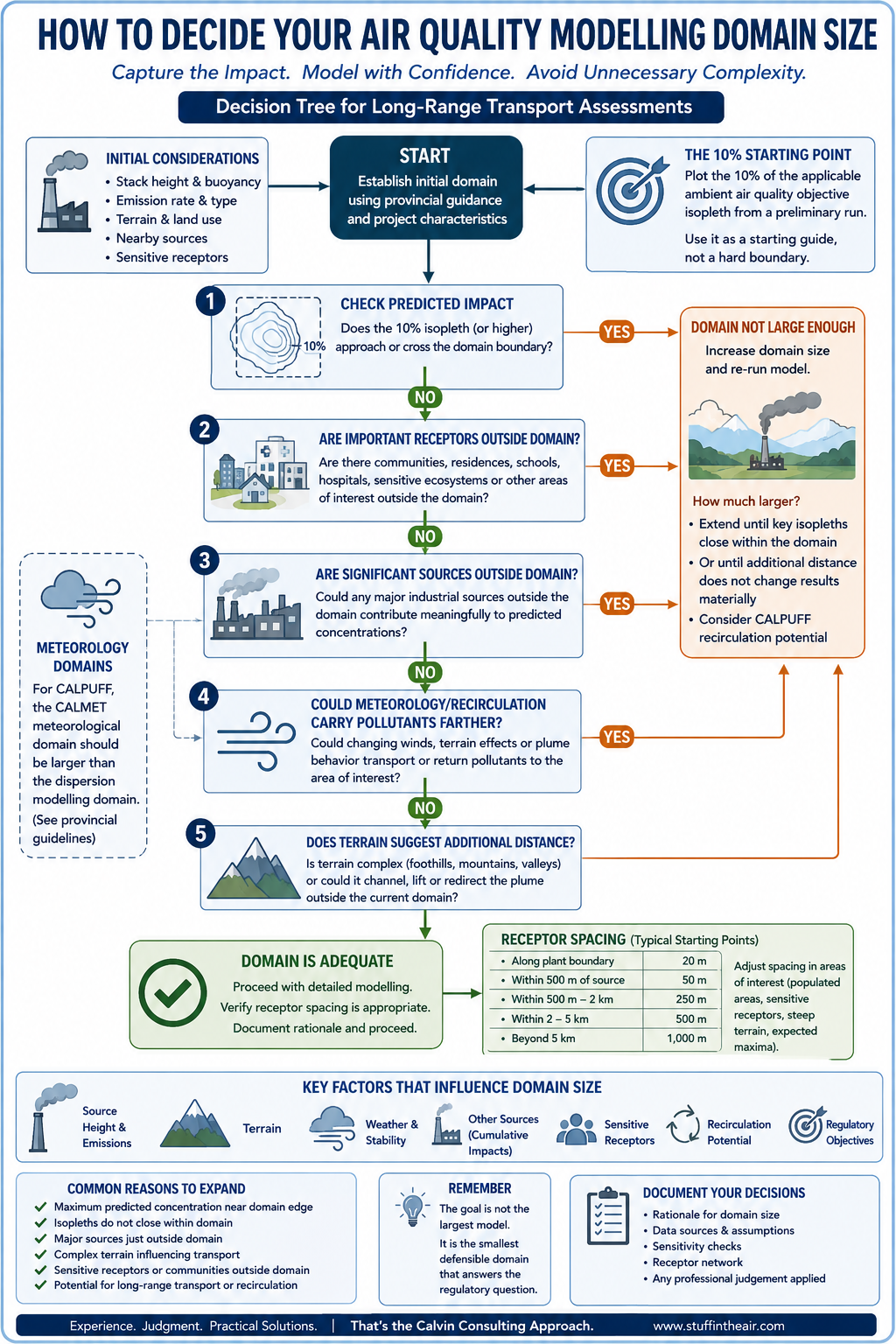
See this quick sketch for help with deciding on your domain.
When we expand the modelling domain
A larger domain can be appropriate for several reasons.
1. The predicted impact approaches the boundary - This is one of the most common triggers.
If the maximum predicted concentration occurs near the edge of the modelling domain or important concentration contours cannot be closed within the domain, the area may need to be expanded.
2. A major source lies just outside the initial area - A distant source is not automatically important.
But if a significant industrial source lies just outside the initial modelling area and could materially affect the concentrations being assessed, it may need to be included.
This is particularly important for cumulative assessments.
3. Terrain could affect the result - In gently rolling terrain, the standard provincial approach will often work very well.
Near mountains, in foothills or in other areas with more complex terrain, the domain may need to be larger so that the model can properly represent the atmospheric behaviour affecting the area of interest.
4. Long-range transport or recirculation may be important - Some meteorological situations can carry pollutants well beyond the facility before they disperse or return toward the area of interest.
Models such as CALPUFF can be useful for situations where long-range transport and recirculation need to be represented.
When we don't expand it
There is an equally important question that often gets overlooked: When is a larger domain unnecessary? For many industrial projects in rural Alberta, the answer is: quite often.
When the terrain is relatively uncomplicated, the facility is isolated from other major industrial sources, and the predicted impacts are comfortably contained within the initial modelling area, expanding the domain may provide little additional value.
A larger model also means more receptors, more emissions data, more processing and potentially more complexity in preparing and interpreting the assessment.
The goal is therefore not to build the largest model possible. The goal is to build a model that is large enough to answer the question properly.
That is an important part of professional modelling judgment.
Receptor spacing: large domain does not mean dense receptors everywhere
Defining the modelling domain is only part of the problem. The model also has to decide where concentrations will actually be calculated. Using a very fine receptor grid everywhere can dramatically increase the amount of modelling without necessarily improving the answer.
Instead, receptor spacing is normally adjusted according to distance from the source, the expected concentration gradients, terrain and areas of particular interest.
For example, BC guidance provides starting points that become progressively wider with distance from the source, while allowing receptor density to be increased in areas such as populated locations or sensitive ecosystems.
This reflects a basic modelling principle: Use enough receptors to capture the concentration pattern...not simply as many receptors as possible.
Areas where a maximum is expected, or where people or sensitive environmental receptors are located, may justify more detailed receptor spacing.
Don't confuse the modelling domain with the CALMET domain
Long-range transport assessments can involve several different areas and they are not necessarily the same.
- Modelling domain - The area over which the dispersion model calculates the pollutant concentrations being assessed.
- Receptor grid - The individual locations where concentrations are calculated within that domain.
- Meteorological domain - The area over which meteorological fields are developed for models such as CALMET.
- Study area - The broader geographic area considered when evaluating sources, receptors, terrain, baseline conditions and potential impacts.
For CALPUFF applications, the CALMET meteorological domain is generally larger than the area being sampled for final concentration predictions. That is because the meteorological model needs enough surrounding information to develop realistic atmospheric flow into and through the area being modelled.
British Columbia: domain selection and receptor spacing
British Columbia provides particularly detailed guidance for situations involving larger modelling domains. The BC guidance recognizes that domain size depends on factors such as stack height, emission characteristics, terrain, sensitive receptors and other sources.
 Contamination risks everywhere
For tall stacks with buoyant emissions, a modelling domain on the order of 50 km by 50 km may be appropriate in some circumstances. Smaller sources may be well represented using considerably smaller domains.
The important point is that 50 km by 50 km is not a universal requirement. It is a possible scale for situations where the source and atmospheric conditions warrant it.
BC guidance also uses the 10% ambient-air-quality-objective contour as a starting point for assessing the appropriate domain and provides progressively wider receptor spacing with distance from the source.
Closer spacing can still be appropriate around:
- populated areas;
- sensitive receptors;
- sensitive ecosystems;
- areas of expected concentration maxima; and
- other locations requiring more detailed assessment.
BC guidance also identifies the need to consider other emission sources and the potential for recirculation in CALPUFF applications.
Alberta: start with the provincial guidance, then look at what the model tells you
Alberta is where Calvin Consulting performs much of its work. For many industrial facilities, particularly isolated facilities in rural areas, the Alberta modelling guidance provides a practical starting point for establishing the modelling domain and receptor network.
 Adding space to air quality maps
The domain should encompass the area where the project could have a meaningful predicted impact, while the source inventory should include industrial sources that could materially affect the assessment.
Alberta assessments generally consider industrial sources within 5 km of the project boundary, with additional sources beyond that distance considered when they could contribute significantly to the predicted concentrations.
This is where modelling judgment becomes important. A source 8 km away is not automatically important merely because it exists. Conversely, a major source just outside the initial area should not automatically be ignored because it falls outside an arbitrary radius.
The practical question is: Could this source make a meaningful difference to the assessment?
Where appropriate, source emissions can be developed from approval limits, Alberta's Annual Emission Inventory Report data, manufacturer information or emission factors.
Baseline air-quality concentrations are also incorporated as required for the assessment scenarios and averaging periods.
A common Alberta situation - For a relatively isolated rural facility in gently rolling terrain, the provincial approach will often produce a modelling area that is more than adequate.
The need to expand the domain usually becomes apparent from the results. For example, if the predicted maximum concentration occurs close to the edge of the model or the concentration isopleths cannot be meaningfully closed, the domain should be reconsidered.
This is generally more useful than selecting an oversized domain from the beginning without evidence that it is needed.
Saskatchewan: domain and source identification
Saskatchewan's modelling guidance similarly focuses on capturing the area where project impacts are significant and considering the factors that can influence dispersion beyond the immediate facility area.
Domain size can vary with:
- source characteristics;
- stack height and buoyancy;
- terrain;
- sensitive receptors;
- nearby emission sources; and
- the potential for broader-scale transport or recirculation.
 Pollution drift captured by expansive models.
For CALPUFF applications, the meteorological modelling domain is also considered separately from the final concentration modelling area. Similar to other provinces, these assessments may also distinguish between pre-project, project-only and post-project conditions when evaluating cumulative effects.
As in Alberta and BC, the important point is not to select a domain mechanically.
The domain needs to be large enough to represent the atmospheric and emissions conditions relevant to the decision being made.
How neighbouring sources can change the answer
Long-range transport is not only about the project's own plume. Existing industrial sources can contribute to the same ground-level concentrations being evaluated.
That means there are really two separate questions:
- Where are the other sources?
- Which other sources could actually matter?
A nearby major facility may need to be included even when it lies outside an initially selected modelling area.
At the same time, including every tiny combustion source or insignificant emission point within a huge radius can create a great deal of work without materially changing the result.
Good cumulative modelling therefore depends on identifying the sources that matter, not simply collecting the largest possible inventory.
The takeaway
Long-range transport does not mean that every industrial facility needs a giant regional model, as for many facilities, a domain based on the provincial guidance will be entirely appropriate.
The domain becomes larger when there is a reason to make it larger, such as predicted concentrations approaching the boundary, concentration isopleths that cannot be meaningfully closed, significant sources just outside the initial area, more complicated terrain, sensitive receptors or atmospheric conditions that could produce important long-range transport or recirculation.
The best domain is therefore not necessarily the largest one. It is the smallest defensible domain that captures the impacts, sources, receptors and atmospheric behaviour that matter to the assessment.
That is where professional modelling judgment makes the difference.
Related air-quality modelling topics
Understanding long-range transport is easier when viewed alongside the other parts of a dispersion assessment:
Air Quality Assessment Reports - How emissions, meteorology, dispersion and regulatory objectives come together in an assessment.
AERMOD vs. CALPUFF - When a local-scale model is appropriate and when a regional or more complex approach deserves consideration.
Meteorological Data for Dispersion Modelling - How weather data drive the predicted dispersion of emissions.
Terrain and Land Use/Land Cover - Why the landscape surrounding a facility matters to atmospheric dispersion.
Building Downwash - How structures can alter plume behaviour close to an industrial facility.
Receptor Selection - How the model determines where concentrations need to be calculated.
NO₂ Modelling - How atmospheric chemistry and background concentrations affect nitrogen dioxide predictions.
Air-Quality Modelling QA/QC - The practical checks that help ensure a technically correct model is also answering the right question.
About Calvin Consulting Group Ltd.
Calvin Consulting Group provides air-quality dispersion modelling and regulatory support for industrial projects across Western Canada.
Our work includes AERMOD, CALPUFF, meteorological processing, terrain analysis, emissions modelling, cumulative assessments and specialized modelling applications.
For a modelling assessment, the important question goes beyond What does the guideline say?
It is also: What does this particular project require us to model? That distinction is where experience matters.
Reach us at:

And get the solution you need.
Clean air is our Passion...Regulatory Compliance is our Business.
A practical domain-selection checklist
Before finalizing an air-quality modelling domain, ask:
Source
- What are the stack heights, release characteristics and expected plume behaviour?
- Could emissions remain significant over a substantial distance?
Terrain
- Is the terrain relatively uncomplicated?
- Are foothills, mountains, valleys or other features likely to affect dispersion?
Predicted concentrations
- Where does the predicted maximum occur?
- Is it comfortably inside the domain?
- Can important concentration isopleths be meaningfully closed?
Receptors
- Are communities or sensitive receptors adequately represented?
- Does any area require more detailed receptor spacing?
Other sources
- Are significant industrial sources located outside the initial domain?
- Could they materially affect the cumulative result?
Meteorology
- Could changing winds or recirculation transport pollutants outside and back into the assessment area?
Final judgment
- Is the domain large enough to answer the regulatory question?
- Is there a reason to make it larger?
- Is there a reason that making it larger would add little value?
Recent Articles


-
Natural Gas Leak Detection: Does YOUR Facility Need it?
Sep 28, 26 08:40 AM
 It's important for industries, especially in the energy sector, to have a natural gas leak detection program. It's often required by law.
 -
Computers in Meteorology | How Would they Help You?
Sep 26, 26 09:40 PM
 Computers in meteorology help us keep track of atmospheric data and make predictions.
 -
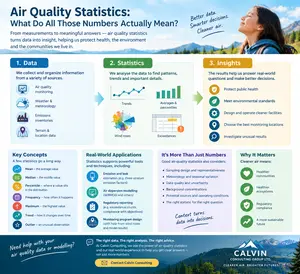
Air Quality Statistics: What Do All Those Numbers Actually Mean?
Sep 21, 26 12:00 AM
 How are air quality statistics used to understand pollution, design monitoring programs, estimate emissions and make environmental decisions?


What an experienced modeller looks for
A modelling guideline gives us the framework. The model results help determine whether the framework is working for the particular project.
Before finalizing a domain, I would typically look at:
The concentration pattern
Are the predicted maxima comfortably contained within the domain, or are they occurring close to the boundary?
The isopleths
Can the important concentration contours be meaningfully closed, or do they simply run into the edge of the model?
Terrain
Is the area relatively straightforward, or could foothills, mountains or other terrain features affect transport?
Source characteristics
Is there a tall, buoyant stack capable of carrying emissions well beyond the immediate area?
Neighbouring sources
Is a significant industrial source located just outside the initial modelling area?
Receptors
Are there communities, residences, hospitals, schools, sensitive ecosystems or other areas that deserve more detailed representation?
Meteorology
Could changing wind directions or recirculation cause the plume to affect areas that would not be obvious from a simple downwind analysis?
This is why domain selection is not simply a matter of entering a number of kilometres into a model.
The objective is to represent the physical problem accurately instead of merely to follow a recipe.
Do you have concerns about air pollution in your area??
Perhaps modelling air pollution will provide the answers to your question.
That is what I do on a full-time basis. Find out if it is necessary for your project.
Have your Say...
on the StuffintheAir facebook page
Other topics listed in these guides:
The Stuff-in-the-Air Site Map
And,
Thank you to my research and writing assistants, and the author remains responsible for the content.
Common mistakes in long-range transport modelling
- Making every domain enormous - A larger domain is not automatically more accurate. It can increase modelling effort without changing the decision.
- Treating 10% as a hard boundary - The 10% contour is a useful starting point, but terrain, sensitive receptors, recirculation and other sources can justify a larger area.
- Assuming 50 km × 50 km is always required - That scale can be appropriate for some tall, buoyant sources, particularly in BC, but it should not be treated as a universal requirement.
- Stopping because the model boundary was reached - A concentration maximum or important isopleth near the edge of the domain deserves attention. The model should not be allowed to define its own boundary simply because the grid ran out.
- Using the same receptor spacing everywhere - A uniform dense grid can be inefficient. More detailed spacing is often most useful where concentration gradients are steep or where people or sensitive environmental receptors are located.
- Ignoring significant sources outside the initial domain - A source does not become irrelevant simply because it is a few kilometres beyond the original modelling boundary.
Most Popular Pages on this Website:
Pictures of Global Warming
- See photos, cartoons, charts, graphs and a few surprises.
Clouds
- Don't know a cumulus from a stratus? Check here.
Causes of Global Warming
- It's not always obvious.
Calgary Alberta Weather
- Example of Canadian Goodness.
Thermometers
- Our favourite weather instrument.
- Home
- Contact Us
- Free E-zine Back Issues
- Privacy Policy
- Site Map - I'll help find something good.

By Barry Lough, P.Met., EP (Environmental Professional)
Text copyright © 2003-2026 Stuff in the Air.com
BACK TO TOP - Hit your 'Home' Key